
Family Chore Chart: How to Make One Everyone Follows
The short answer: list the chores your home really needs, give each one a single owner and a day, put the chart where everyone sees it, and review it together once a week. A family chore chart gets followed when it covers the whole family, adults included, and when nobody has to ask whose job something is.
The American Academy of Pediatrics (AAP) makes the same point in its guide to chores: a chore chart or checklist "acts as a visual reminder to keep all members of the family on task."
The quick version
- List the chores, the daily ones and the weekly ones.
- One owner per chore. A name, not "the kids" or "whoever".
- Give it a day, or a moment in the day for daily jobs.
- Say what done means for the jobs that cause arguments.
- Put it where everyone sees it: fridge, whiteboard or a shared app.
- Reset weekly. Ten minutes to check what worked and swap what didn't.
What goes on the chart
Every row needs four things: the chore, who owns it, when it happens, and a place to mark it done.
Start with the list. Walk through a normal week and write down what actually gets done, including the jobs nobody sees, like planning meals or filling in school forms. Our household chores list for adults is a full list to pick from, room by room.
Keep the first version short. The AAP says that with a school-age child who hasn't had chores before, you should "introduce one new task at a time; a long list can be overwhelming." Ten to fifteen rows for the whole family is plenty to start.
Three layouts to copy
The examples use one family of four: two adults, Robin and Jamie, and two kids, Mia (10) and Sam (6). Swap in your own names and jobs.
Layout 1: By person
Each person gets a row with their daily and weekly jobs. This is the easiest chart for kids to read: find your name, read across.
| Who | Every day | Every week |
|---|---|---|
| Robin | Dinner (turns) | Laundry, groceries |
| Jamie | Dinner (turns) | Trash out, bathroom |
| Mia | Clear the table | Vacuum |
| Sam | Set the table, feed the cat | Wastebaskets |
Good for: younger kids, and jobs that stay with one person.
Layout 2: By day
Daily jobs stay on a short list at the top. The weekly jobs are spread over the week, one a day, so Saturday isn't a four-hour clean.
| Day | Job | Who |
|---|---|---|
| Mon | Laundry | Robin |
| Tue | Trash and recycling out | Jamie |
| Wed | Vacuum the living room | Mia |
| Thu | Empty the wastebaskets | Sam |
| Fri | Groceries | Robin |
| Sat | Clean the bathroom | Jamie |
| Sun | Family reset | Everyone |
Good for: busy weeks. Agree that a missed job moves to the next day and stays with its owner.
Layout 3: Rotating
The jobs nobody wants take turns. Each week everyone moves one job along, so no one is stuck with the dishes forever.
| Week | Robin | Jamie | Mia |
|---|---|---|---|
| 1 | Dishes | Sweep | Vacuum |
| 2 | Vacuum | Dishes | Sweep |
| 3 | Sweep | Vacuum | Dishes |
Sam is 6, so he keeps his fixed jobs for now and joins the rotation when he can do every job on it.
Good for: fairness, and for teaching older kids every job. Our chore rotation guide covers the patterns, weeks away and missed turns.
Most families mix them: fixed jobs by person, weekly jobs by day, and two or three disliked jobs on rotation.
A sample chart for a family of four
Here is the whole chart for Robin, Jamie, Mia (10) and Sam (6).
| Chore | Who | When |
|---|---|---|
| Cook dinner | Robin, Jamie (turns) | Daily |
| Load the dishwasher | Robin, Jamie, Mia (turns) | Daily |
| Set the table | Sam | Daily |
| Clear the table | Mia | Daily |
| Feed the cat | Sam | Daily |
| Make your bed | Mia, Sam | Daily |
| Laundry | Robin | Mon |
| Put your laundry away | Mia, Sam | Mon |
| Trash and recycling out | Jamie | Tue |
| Vacuum the living room | Mia | Wed |
| Empty the wastebaskets | Sam | Thu |
| Groceries and meal plan | Robin | Fri |
| Clean the bathroom | Jamie | Sat |
| Bills and school forms | Jamie | Sun |
Each adult owns about the same number of jobs, and the kids' jobs are real ones the household needs.
Share it between the adults too
A chart that only lists the kids says chores are something children do, while the adults' work stays invisible. Put the cooking, the laundry, the bills and the bathroom on the same chart, with names.
It helps the kids. The American Academy of Child and Adolescent Psychiatry (AACAP) tells parents in its chores fact sheet to "be a good role model", because children learn more easily "if they see others in the family doing the same."
It also helps the adults: once every job has a name next to it, an uneven split is easy to see. If that's the real argument in your house, our guide to splitting chores with a partner goes through it step by step.
What kids can take on, by age
The AAP and the AACAP both publish lists. A few examples from each:
- 5 to 7: set and clear the table, make their own bed, fill the pet's food dish, empty wastebaskets, sweep floors (AAP).
- 7 to 9: load and unload the dishwasher, help with meal preparation, pack their own school lunch (AACAP).
- 8 to 10: vacuum, help make dinner, put away their own laundry and the groceries (AAP).
- 11 to 12: clean the kitchen, change bedsheets, do and fold laundry, clean the bathroom (AAP).
For teens, the AAP's article on chores for teens adds vacuuming shared spaces, cleaning the kitchen after meal prep and pet care, among others.
These are guides, not tests. The full lists for ages 2 to 17, with safety notes for jobs like mowing, are in chores for kids by age.
Daily jobs and weekly jobs
The AAP says to make sure children understand what is expected of them "on a daily and a weekly basis." Treat the two differently on the chart.
- Daily jobs need a moment, not a day: before dinner, after breakfast, before bath. The AAP suggests encouraging kids "to do their chores at the same time each day", and the AACAP's example of a routine is "Clean up before dinner."
- Weekly jobs need a day. "Vacuum on Wednesday" gets done. "Vacuum sometime this week" gets done on Sunday night, by a parent.
Monthly and seasonal jobs don't belong on a family chart. Keep those on a separate house cleaning schedule.
Agree what "done" means
"Clean the kitchen" means something different to a 10 year old than it does to you. The AACAP's first tip is to "let your child know exactly what needs to be done."
For any job that causes arguments, write the finish line next to it:
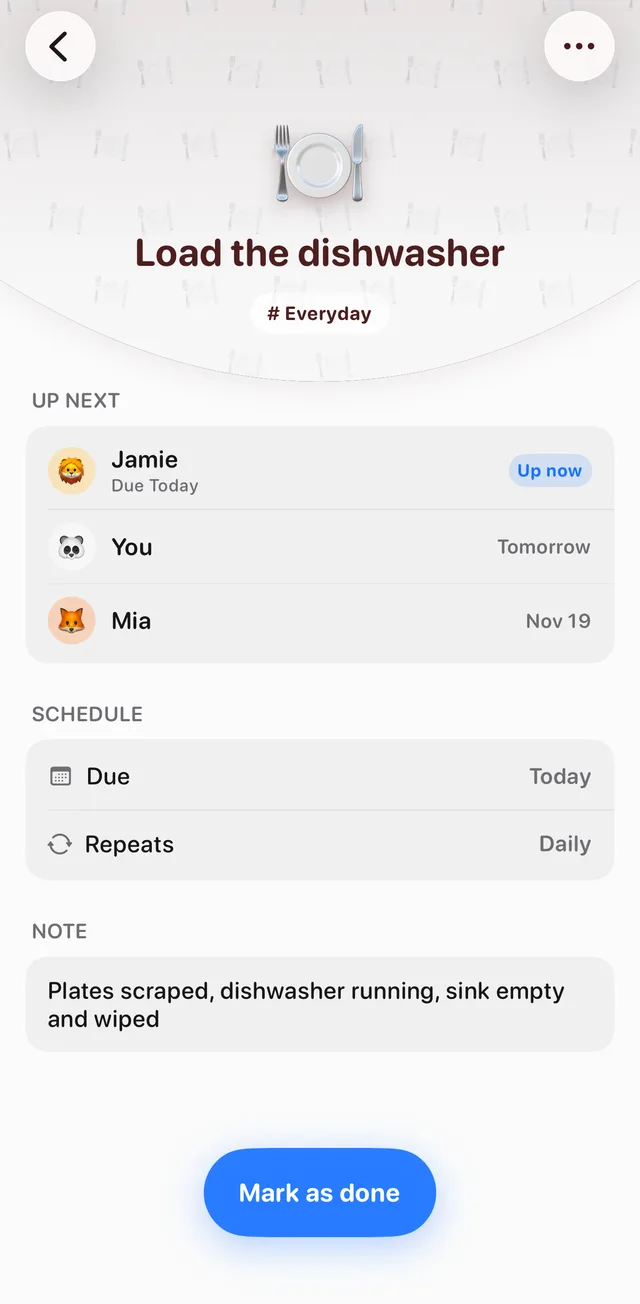
- Load the dishwasher: plates scraped, dishwasher running, sink empty and wiped.
- Set the table: plates, forks, knives, cups and water for everyone.
- Clean the bathroom: toilet, sink, mirror, shower and floor.
This goes for adults as well. Once the standard is written down, accept any result that meets it. The AAP's advice is not to expect perfection and to praise the effort, not the outcome.
The weekly family reset
The AAP recommends regular family meetings to review progress, ask kids "for their ideas about chores" and create new or modified agreements. Ten minutes on Sunday is enough:
- What got done? Say thank you for it, specifically.
- What kept getting skipped? Ask why before fixing it. Wrong day? Too hard? Unclear?
- Any swaps? Let people trade jobs they hate, adults included.
- Anything new this week? A school trip, guests, a parent traveling.
Then update the chart on the spot, while everyone is still at the table.
A note on allowance
Whether to tie money to chores is your family's call. The AAP says "you may also want to consider tangible rewards like allowances and stickers tied to completed chores", next to honest praise. The AACAP suggests a "star chart or reward system with specific goals." Neither says it's required. Whatever you choose, keep the rule the same every week.
When the chart stops being followed
Charts slip. Before you declare yours dead, check the usual causes:
- It's out of date. Pick one person and a day to update it, or use something that updates itself.
- It's too long. The AAP warns that kids given too much "may feel overwhelmed and resist taking on any responsibilities at all." Cut it back to the jobs that matter most.
- Jobs have no single owner. Split shared jobs or rotate them.
- Only the kids are on it. Add the adults' jobs.
- Every miss ends in nagging. The AAP is blunt: "Badgering or scolding a child is not an effective method to get them to accept more responsibility." Our guide to getting kids to do chores without nagging covers what to do instead.
Then restart at the next weekly reset with a shorter chart.
Paper, whiteboard or app
- Paper on the fridge: free, and younger kids can tick their own boxes. It needs reprinting when anything changes.
- Whiteboard: easy to edit at the weekly reset, but one swipe of a sleeve erases the record, and someone has to move the rotation on.
- A shared app: on every adult's and teen's phone, and repeating jobs and turns can move on by themselves. Younger kids only see it when you show them, so a paper list for the little ones can sit next to it.
The roommate chore chart post compares these in more detail, with a printable.
The family chart in Tidy Up
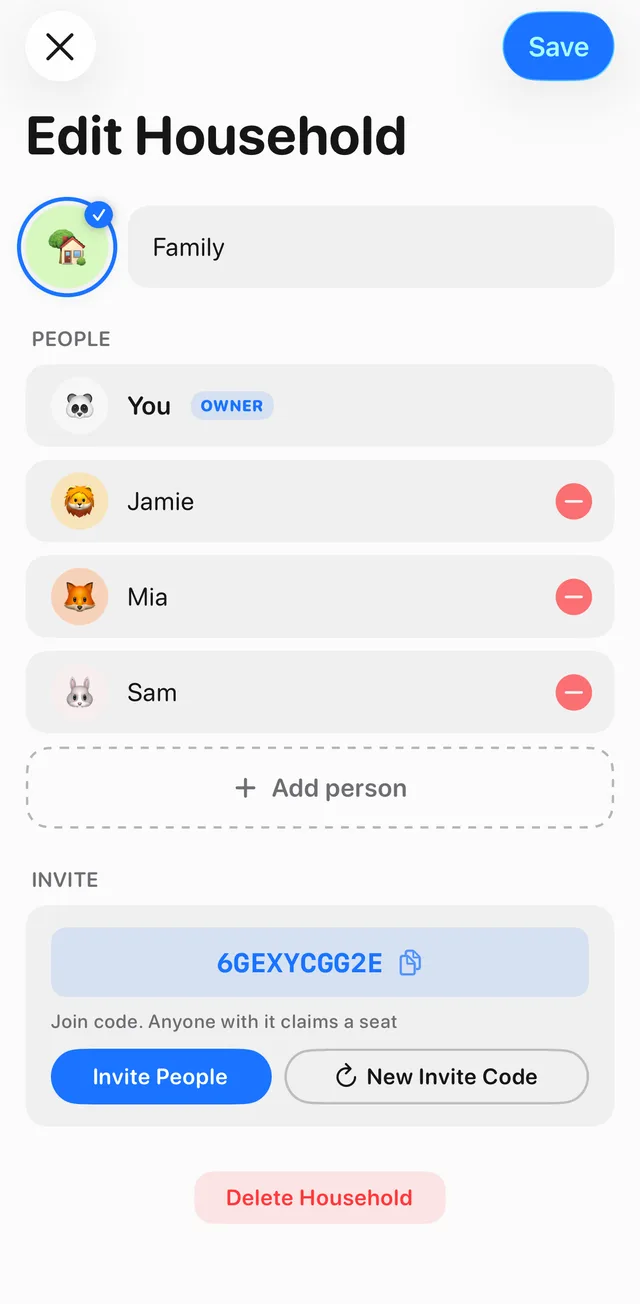
Tidy Up is the shared version of this chart. You create a household and add each person by name, with an emoji and a color. Kids don't need a phone or an account to be on it: you assign chores to their name and tick them off for them.
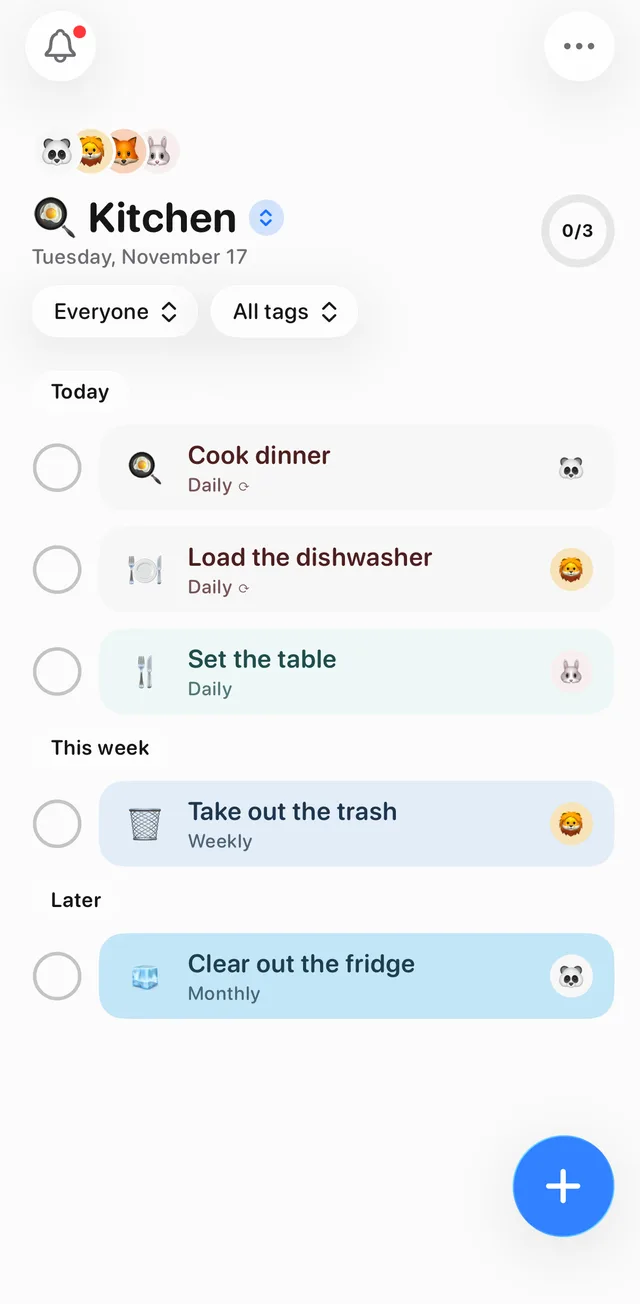
Each room is a space with its own chores. A chore has one owner, several, or anyone, and repeats daily, weekly, every 2 weeks, monthly, every 3 months or yearly. Ticked off today, a daily chore comes back tomorrow.
For shared jobs, turn on rotation. Each tick moves the turn to the next person, and the chore shows who's up now and who's next. A chore can carry a note too, which is a good home for what "done" means.
Your partner, or a teen with their own iPhone, can join the household with its 10-character code and claim the spot you made for them (joining needs a sign-in with Apple or Google). They get a notification when a chore is assigned to them or rotates to them. For the weekly reset, the Ranking tab lists who completed what this week.
Tidy Up doesn't handle allowances or rewards. It's free for unlimited people and chores, with up to 5 spaces you create per household and rotation on up to 3 chores. Tidy Up+ adds unlimited spaces and rotation and a morning digest of what's due today.

Tidy Up: chores, schedules and turns
Invite your household with one code, set chores to repeat on a schedule, let them rotate so everyone takes turns, and see who did what in the weekly ranking. Free to start, no ads.

Common questions
What should be on a family chore chart?
Every chore the household shares, each with one owner, a day or a moment in the day, and a place to mark it done. Include the adults' jobs, not only the kids'.
How many chores should each child have?
There's no official number. The AAP says to introduce one new task at a time and to avoid overloading kids, so start with one or two daily jobs and add more as each becomes routine.
Should parents be on the family chore chart?
Yes. The AACAP advises parents to be a good role model, and a chart with everyone's jobs on it makes the split visible for the adults too.