
House Cleaning Schedule: What to Clean Daily, Weekly, Monthly and Yearly
The short answer: do a few small things every day (dishes, counters, a quick tidy), clean the bathroom, floors and sheets once a week, and spread everything else across every 2 weeks, monthly, every 3 months and once a year. Add the handful of safety checks that have official guidance, like testing smoke alarms every month, and you have a schedule that keeps a home clean without a cleaning marathon.
Here is the whole schedule by frequency, then the same jobs by room, so you can copy whichever version suits your home.
The schedule at a glance
| How often | What to clean |
|---|---|
| Daily | Dishes, kitchen counters and stove, a 10-minute tidy, make the bed |
| Weekly | Bathroom, vacuum and mop, sheets and towels, trash, old leftovers, microwave |
| Every 2 weeks | Clear out the fridge, wash bath mats, dust shelves and blinds |
| Monthly | Test smoke alarms, check the HVAC filter, wipe cabinet doors, dishwasher filter |
| Every 3 months | Clean the oven, wash pillows and curtains, clean behind the dryer |
| Yearly | Replace 9-volt smoke alarm batteries, clean behind big appliances, wash windows inside and out |
Most of this is habit, not rule. Nobody official says you have to vacuum weekly; it's just the rhythm most homes need. The few jobs with real safety guidance behind them are marked and linked below.
Daily: 15 minutes
Daily jobs are the ones that get much worse if you skip them. Keep the list short enough that you'd actually do it on a tired Tuesday.
- Dishes: washed, or loaded and the dishwasher run. Nothing left soaking overnight.
- Kitchen counters and stove: wiped after the last meal of the day.
- Cutting boards: washed with hot, soapy water after each use, which is what the USDA Food Safety and Inspection Service recommends.
- Lint filter: cleaned before and after every dryer load. The US Fire Administration lists an uncleaned lint filter and vent as a dryer fire risk.
- A quick tidy: 10 minutes putting things back where they live. Shoes, mail, cups, chargers.
- Make the bed, if you like starting the day that way.
Weekly: one bigger job a day
Weekly jobs are where most of the actual cleaning happens. Spreading them across the week (bathroom Monday, floors Wednesday, sheets Saturday) works better for most people than saving them all for one weekend morning.
- Bathroom: toilet, sink, mirror, shower or tub, and the floor.
- Vacuum and mop the floors, starting with the rooms you use most.
- Sheets and towels: wash and change.
- Trash and recycling out on collection day.
- Fridge check: throw out old leftovers. FoodSafety.gov gives cooked leftovers 3 to 4 days in a fridge at 40°F or below, so a weekly sweep catches everything past its time.
- Dust the surfaces people actually see: TV stand, coffee table, nightstands.
- Wipe out the microwave before the splatters bake on.
- Sponge: sanitize or replace it. No official body sets a frequency, so weekly is our suggestion. For the method, USDA researchers found that microwaving a wet sponge for one minute or running it through the dishwasher with a drying cycle killed far more bacteria than a bleach or lemon juice soak.
Every 2 weeks
These are the jobs that don't need doing weekly but look bad by the end of the month.
- Clear out the fridge: wipe the shelves and the door bins, not just the old food.
- Wash the bath mats and the kitchen hand towels.
- Dust the higher and lower spots: shelves, blinds, baseboards.
- Vacuum under the sofa cushions and in the corners the robot misses.
Monthly
Monthly is where the safety checks live, so it's worth putting these on a real schedule instead of trusting your memory.
- Test the smoke alarms. The US Fire Administration says to test smoke alarms every month, whatever kind of battery they use.
- Check the HVAC filter. ENERGY STAR, the EPA's efficiency program, says to inspect, clean or change the air filter in your central air conditioner, furnace or heat pump once a month. A dirty filter costs energy and can damage the equipment.
- Sanitize the cutting boards. USDA's method: 1 tablespoon of unscented liquid chlorine bleach per gallon of water, flood the surface, let it stand for several minutes, rinse and air dry. Monthly is our suggestion for a home that already washes boards after each use; the USDA page doesn't set an interval. It does say to throw a board out once it's badly worn or has grooves that are hard to clean.
- Wipe cabinet doors, handles and light switches.
- Clean the dishwasher filter, following the manual for your model.
- Vacuum the mattress and the upholstered furniture.
Every 3 months
The seasonal jobs. A good trick is to tie them to the start of each season so they come round on their own.
- Clean the oven.
- Wash the pillows, duvet and curtains, if the care labels allow it.
- Clean behind the dryer and check the vent. The US Fire Administration's dryer flyer says to clean the back of the dryer where lint builds up, check that the vent behind it isn't damaged, crushed or restricted, and make sure the outdoor vent cover opens when the dryer runs. It doesn't give an interval; every 3 months is our pick.
- Deep clean the bathroom grout and wash the shower curtain.
- Flip or rotate the mattress, if the manufacturer recommends it.
Yearly
Once a year sounds easy until three years have gone by. Give each of these a date.
- Replace 9-volt smoke alarm batteries. The US Fire Administration says at least once a year for alarms that run on a 9-volt battery, and for the backup battery in hardwired alarms. Sealed 10-year alarms don't need new batteries; follow the manufacturer's instructions.
- Check the date on your smoke alarms. The same USFA page says to replace the whole alarm every 10 years. The manufacture date is printed on the back.
- Clean behind and under the big appliances: fridge, stove, washer.
- Wash the windows inside and out, and the screens.
- Clear out one storage space: closet, garage, under the bed.
The same schedule by room
If you'd rather clean one room at a time, here is the same list sorted by room.
- Kitchen. Daily: dishes, counters, cutting boards. Weekly: trash, fridge check, floor. Every 2 weeks: fridge shelves. Every 3 months: oven. Yearly: behind the fridge.
- Bathroom. Daily: wipe the sink. Weekly: full clean, towels. Every 2 weeks: bath mats. Every 3 months: grout and shower curtain.
- Bedrooms. Daily: make the bed. Weekly: sheets, dust. Monthly: vacuum the mattress. Every 3 months: pillows and duvet.
- Living room. Daily: quick tidy. Weekly: vacuum, dust. Every 2 weeks: under the cushions. Every 3 months: curtains.
- Laundry. Every load: lint filter. Every 3 months: behind the dryer and the vent.
- Whole home. Monthly: test the smoke alarms, check the HVAC filter. Yearly: smoke alarm batteries, windows.
Make it fit your home
A schedule only works if it fits the time you actually have. A few ways to cut it down:
- Living alone? Fewer dishes and less laundry, but the same weekly bathroom and the same safety checks. Many single people get by with the daily list plus one weekly job a day.
- Short on time? Keep the daily list to dishes and counters, and do one weekly job a day instead of a big weekend clean. Fifteen minutes beats three hours you never find.
- Shared home? Split the weekly jobs and rotate the ones nobody wants. Our guides to splitting chores with roommates and splitting chores with a partner walk through how.
- Kids or pets? Expect the daily tidy and the floors to need more. Add a section for them rather than squeezing it into the existing list.
Share it with your household
The hardest part of any cleaning schedule is the jobs that come round once a month or once a year. Nobody forgets the dishes. Everybody forgets the smoke alarms.
This is what Tidy Up was built for. Each room or area of your home is a space with its own chores, and every chore can repeat daily, weekly, every 2 weeks, monthly, every 3 months or every year. When someone ticks a repeating chore off, it moves to its next due date by itself, and each room's list is sorted into Overdue, Today, This week and Later.
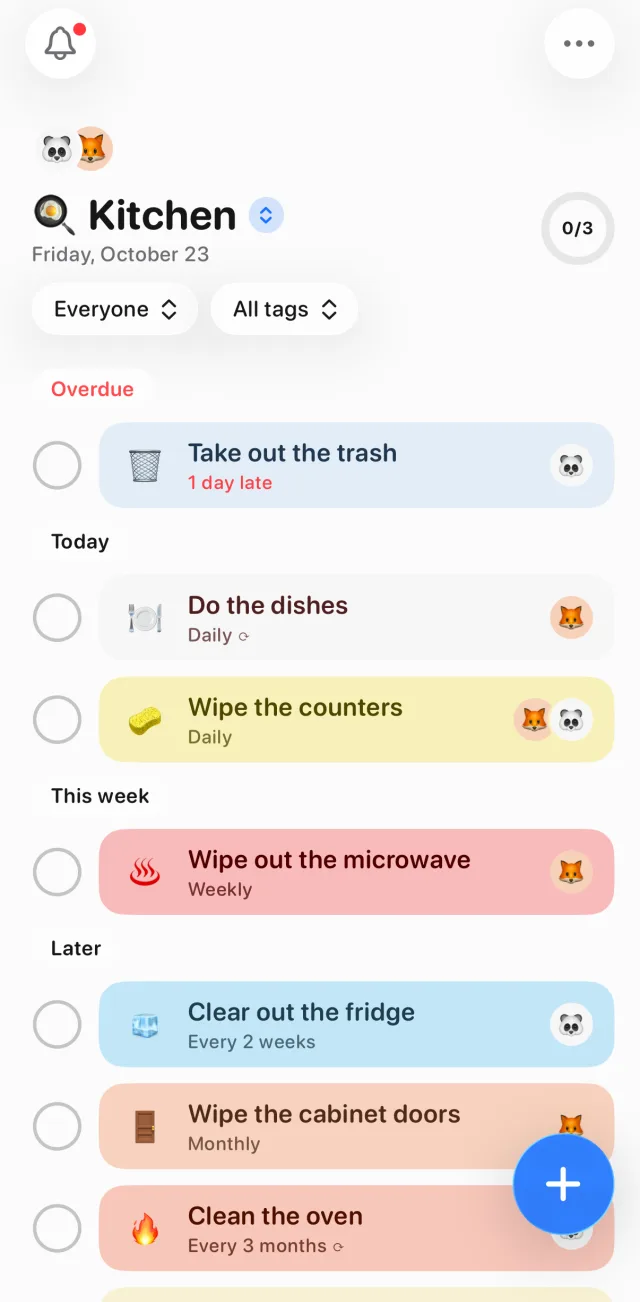
Setting a chore's schedule is one row of options in the chore form.
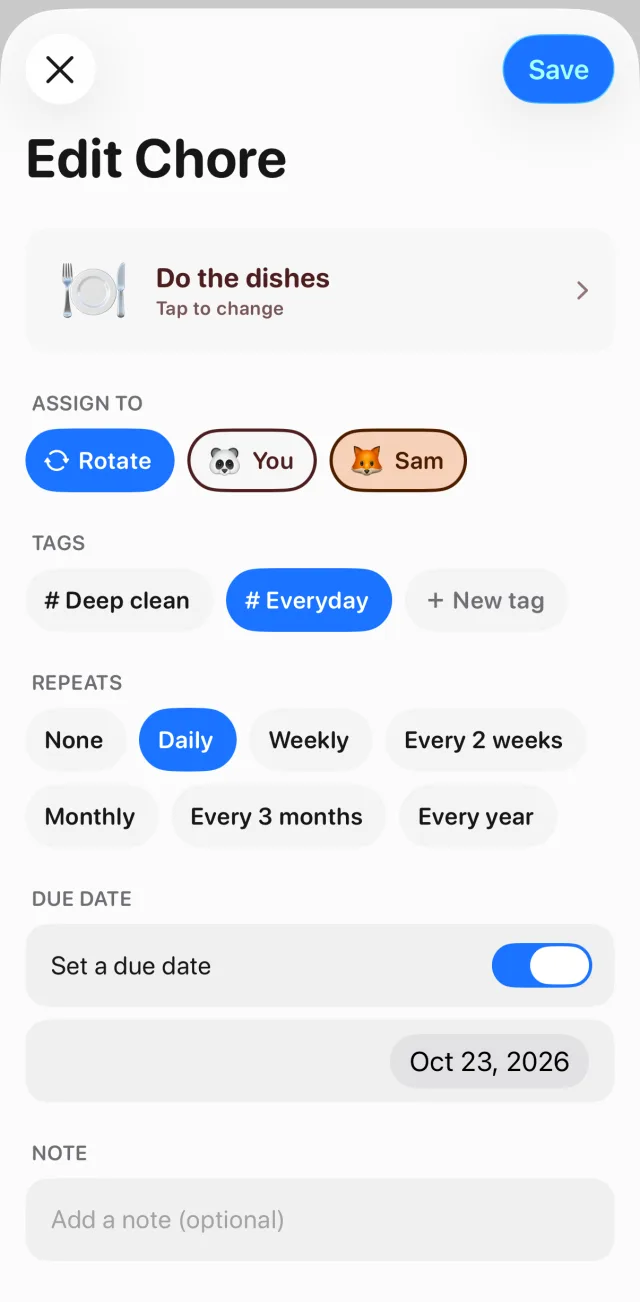
The monthly and yearly safety checks get a space of their own. Add a "Whole Home" area for the smoke alarms, the HVAC filter and the battery swap, and they show up under Later until it's their week.
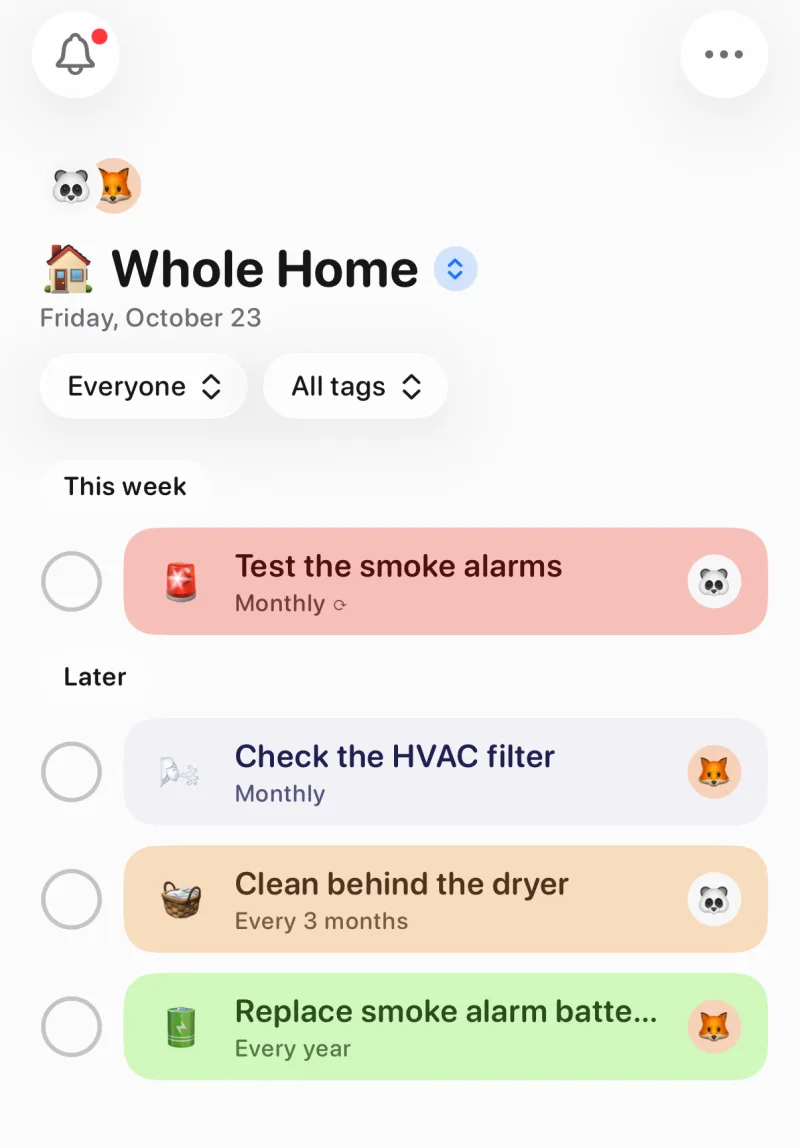
To share it, invite your household with the 10-character join code. Everyone sees the same rooms and the same schedule, and a chore can go to one person, several, or anyone. For the jobs nobody wants, like the bathroom or the oven, turn on rotation and the turn moves to the next person each time it's done. A note on a chore keeps the details in one place, like "Change it if it looks dirty" on the HVAC filter.
Tidy Up is free for unlimited people and chores, with up to 5 spaces you create per household and rotation on up to 3 chores. Tidy Up+ adds unlimited spaces and rotation and a morning digest of what's due today.

Tidy Up: chores, schedules and turns
Invite your household with one code, set chores to repeat on a schedule, let them rotate so everyone takes turns, and see who did what in the weekly ranking. Free to start, no ads.

Common questions
What should I clean every day?
Keep it to the jobs that get worse fast: dishes, kitchen counters and stove, a quick tidy of the main rooms, and the dryer's lint filter whenever you run a load. Fifteen minutes is enough for most homes.
What should be on a weekly cleaning schedule?
The bathroom, vacuuming and mopping, sheets and towels, trash and recycling, dusting the main surfaces, and a fridge check for old leftovers. Spread them out, one job a day, if a big weekly clean keeps getting skipped.
How often should you deep clean your house?
There's no official rule. A practical rhythm is a few deeper jobs every month, a seasonal round every 3 months (oven, pillows, curtains, behind the dryer) and a yearly round for behind the appliances, the windows and storage. That way you never need a whole deep-clean weekend.
How often should I test my smoke alarms?
Every month, according to the US Fire Administration. Replace 9-volt batteries at least once a year, and replace the alarm itself every 10 years.
How do I stick to a cleaning schedule?
Make the daily list short, give the weekly jobs fixed days, and put the monthly and yearly jobs somewhere that reminds you, not on a list you have to remember to check. In a shared home, put names next to the jobs so nothing belongs to "someone".