
How to Split Chores With Roommates (Without the Passive-Aggressive Notes)
The short answer: write down every shared chore, agree what "done" looks like, split the jobs so everyone's week is about the same amount of work, rotate the ones nobody wants, and keep the list somewhere everyone can see it. Then check in after two weeks and fix what isn't working.
That is the whole system. The rest of this guide walks through each step, with sample splits you can copy for two, three and four roommates.
The quick version
- List every shared chore and how often it needs doing.
- Agree on a standard for the big ones: what "clean bathroom" actually means.
- Pick a split method: rotate everything, fixed jobs by preference, or one zone each.
- Put it where everyone sees it, with names and days, not "we'll all just pitch in".
- Check in after two weeks and adjust before resentment builds.
Step 1: List every shared chore
Most roommate fights are not about the dishes. They are about the jobs one person does quietly that nobody else notices: buying toilet paper, cleaning the fridge, taking the recycling down. Get them all on paper first.
Sit down together for 15 minutes and go room by room. Only shared spaces count; everyone's own bedroom is their own business.
| Area | Chore | How often |
|---|---|---|
| Kitchen | Wash or load dishes, wipe counters and stove | Daily |
| Kitchen | Clean the fridge, toss old food | Every 2 weeks |
| Kitchen | Mop the floor | Weekly |
| Trash | Take out trash and recycling | Weekly, or when full |
| Bathroom | Clean toilet, sink, shower and mirror | Weekly |
| Bathroom | Wash bath mats, restock toilet paper and soap | Every 2 weeks |
| Living room | Vacuum, dust, clear the clutter | Weekly |
| Hallway and entry | Sweep, sort the shoes and mail | Weekly |
| Shared supplies | Buy dish soap, sponges, cleaning spray, trash bags | When low |
| Anything else | Water the plants, feed the cat, bills | Agree together |
Add anything specific to your place. If someone says "I already do that every week", that is exactly the kind of chore that needs to be on the list.
Step 2: Agree what "clean" means
One roommate's clean bathroom is another's "you wiped the sink". Before you assign anything, agree on a short definition for the chores that cause trouble. For example:
- Bathroom done means toilet, sink, mirror and shower cleaned, floor wiped, trash emptied.
- Kitchen done means no dishes in the sink overnight, counters wiped, stove clear.
- Trash done means bags out and a new bag in the bin.
Write these next to the chore so nobody has to argue about it later. A one-line note does the job.
Agree on "done", not on "how". If the bathroom ends up clean, it doesn't matter whether someone uses spray or wipes, mornings or Sunday nights.
Step 3: Pick a way to split
There is no single fair split. There are three common ones, and the right choice depends on how your household works.
| Method | How it works | Good for | Watch out for |
|---|---|---|---|
| Rotate everything | Each chore moves to the next person every week | Roommates who all dislike the same jobs | Someone who skips a week leaves a mess for the next person |
| Fixed jobs by preference | Everyone picks what they mind least and keeps it | People with strong likes and dislikes | Jobs feel unequal over time; review them every month |
| One zone each | Each person owns a room or area | Big places, very different schedules | Kitchen and bathroom are much more work than the hallway |
Many households end up with a mix: everyone keeps the jobs they don't mind, and the jobs nobody wants (bathroom, trash) rotate. That mix is usually the easiest to keep going.
Weigh the chores, not just count them
Cleaning the bathroom is not the same as watering the plants. A simple way to keep it fair is to give each chore a rough weight, like 1 for a quick job and 3 for a big one, and make sure each person's weekly total is about the same. You don't need to be exact. You just need everyone to look at the list and agree it's fair.
Sample splits for 2, 3 and 4 roommates
Use these as a starting point. "Rotates" means the job moves to the next person each week.
Two roommates
| Chore | Roommate A | Roommate B |
|---|---|---|
| Dishes | Their own, every day | Their own, every day |
| Kitchen wipe-down and floor | Rotates weekly | Rotates weekly |
| Bathroom | Rotates weekly | Rotates weekly |
| Trash and recycling | ✓ | |
| Vacuum and dust living room | ✓ | |
| Restock supplies | ✓ | |
| Clean the fridge | ✓ |
With two people, alternating weeks on the big jobs is the simplest fair split. Each person does the bathroom every other week.
Three roommates
| Chore | Week 1 | Week 2 | Week 3 |
|---|---|---|---|
| Kitchen (counters, stove, floor) | A | B | C |
| Bathroom | B | C | A |
| Trash, recycling, living room | C | A | B |
Three roommates fit a simple three-job rotation: each week everyone has exactly one area, and every three weeks everyone has done everything once. Daily dishes stay personal: you use it, you wash it.
Four roommates
| Chore | Week 1 | Week 2 | Week 3 | Week 4 |
|---|---|---|---|---|
| Kitchen | A | B | C | D |
| Bathroom | B | C | D | A |
| Living room and hallway | C | D | A | B |
| Trash, recycling, supplies | D | A | B | C |
If you have two bathrooms, let each bathroom's users clean their own and rotate the rest.
Step 4: Put it where everyone can see it
A split only works if everyone knows whose turn it is without asking. A whiteboard on the fridge works until someone wipes it. A shared spreadsheet works until nobody opens it.
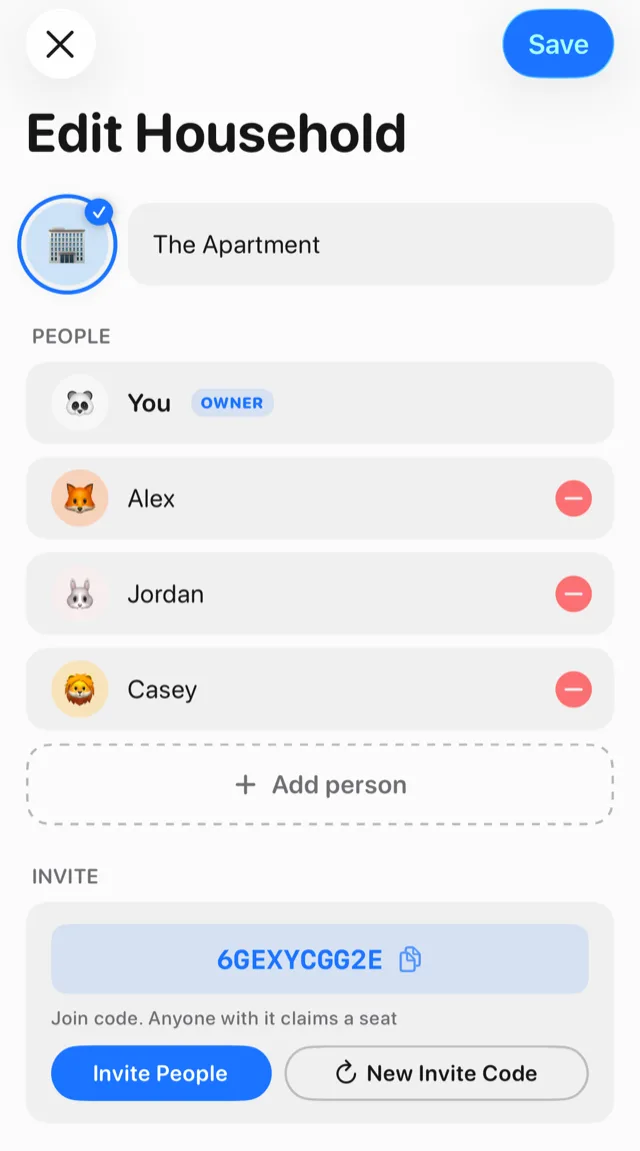
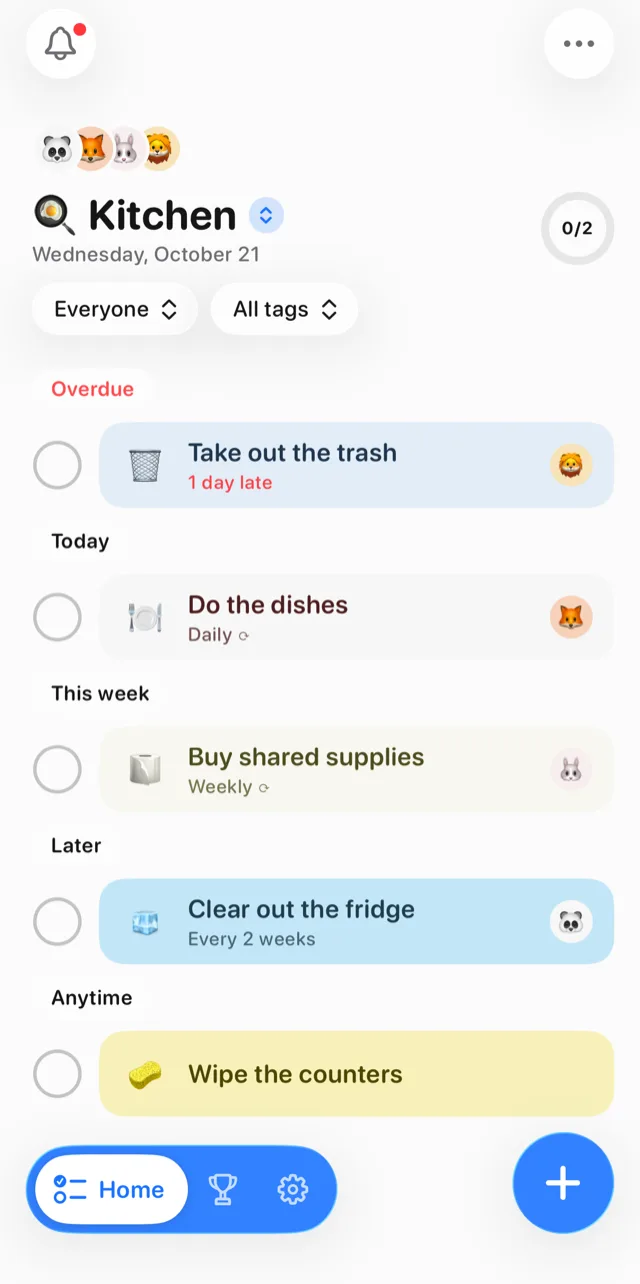
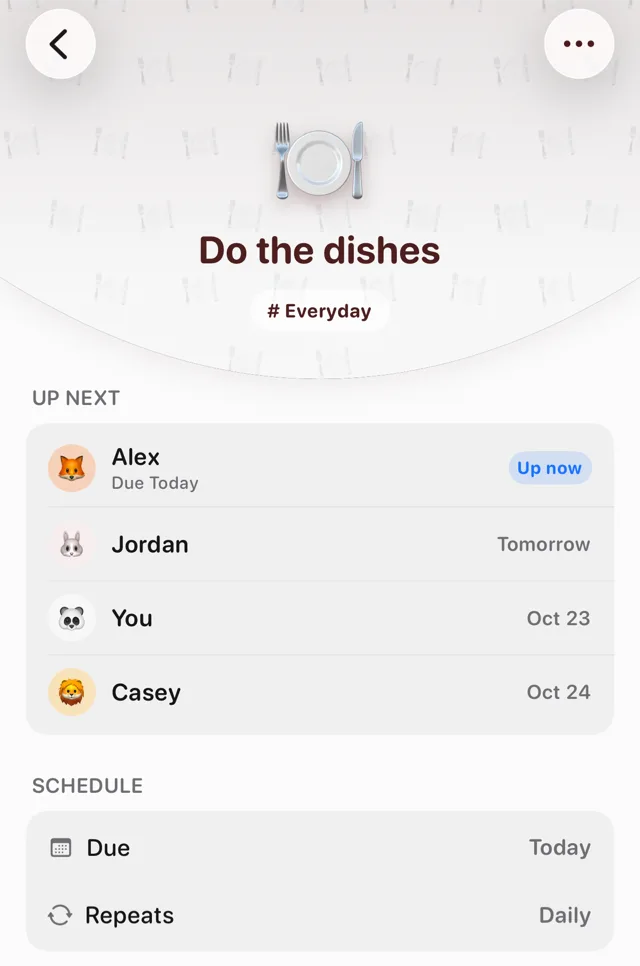
This is the part Tidy Up was built for. Everyone joins your household with one invite code, each chore gets a schedule (daily, weekly, every 2 weeks and so on) and the people who share it. Turn on rotation and the app keeps the order: when a chore is ticked off, the turn moves to the next roommate, and everyone sees who is up.
Tidy Up is free for unlimited people and chores, with rotation on up to 3 chores per household. Tidy Up+ unlocks unlimited rotation and more spaces.
Step 5: Check in, and deal with the roommate who doesn't
Set a date two weeks out for a five-minute check-in. Ask two questions: is the split still fair, and is anything not getting done? Swap jobs if someone's schedule changed. It is much easier to adjust early than after a month of quiet resentment.
If one roommate keeps skipping:
- Start with facts, not feelings. "The bathroom was your week and it didn't get done" is easier to hear than "you never clean".
- Ask what's in the way. Night shifts, exams or travel are real. Swap them onto chores that fit their schedule.
- Agree on a consequence together, like doing the next turn too, or paying toward a cleaner for that week.
- Keep a visible record. When everyone can see who did what, it stops being one person's word against another's.

Tidy Up: chores, schedules and turns
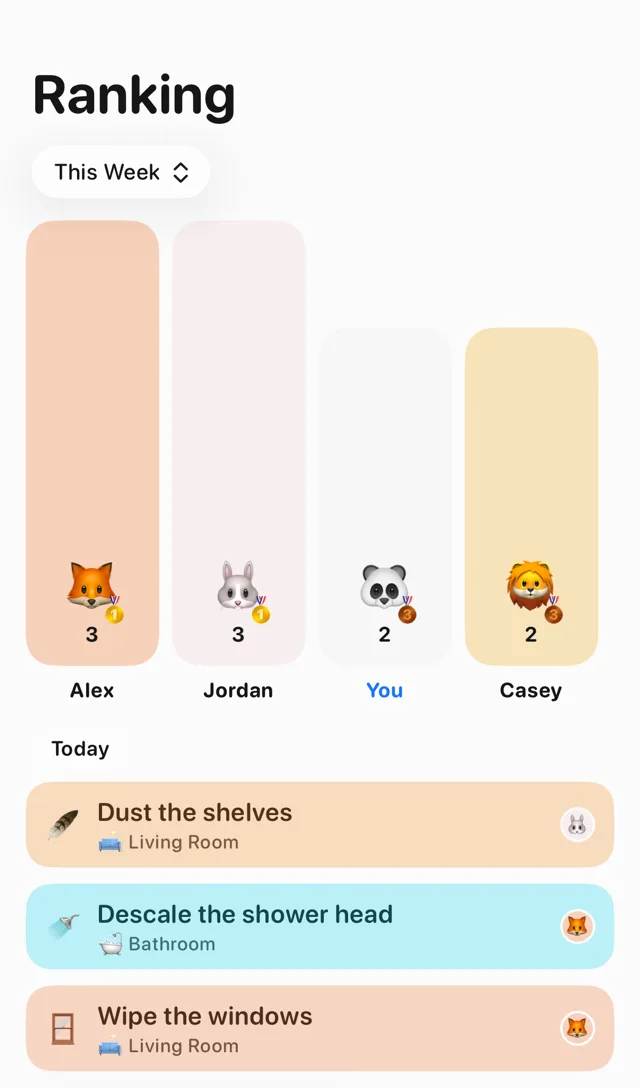
Invite your household with one code, set chores to repeat on a schedule, let them rotate so everyone takes turns, and see who did what in the weekly ranking. Free to start, no ads.

Common questions
What's the fairest way to split chores with roommates?
The fairest split is one everyone agrees to after seeing the full list. In practice, that usually means each person keeps the jobs they mind least, and the jobs nobody wants, like the bathroom and the trash, rotate weekly.
Should roommates clean their own dishes?
For most households, yes. "You use it, you wash it" avoids the most common fight. Put the shared jobs, like wiping counters and cleaning the stove, on the rotation instead.
How do you split chores between 3 roommates?
Split the shared work into three areas, for example kitchen, bathroom, and trash plus living room, and rotate them weekly. Everyone has one area each week, and the load evens out every three weeks.
What if one roommate works much longer hours?
Fair doesn't have to mean identical. They can take quick jobs that fit around shifts, like trash and supplies, while someone with more time at home takes the bigger cleaning. Agree on it out loud so nobody feels short-changed.
How do you get a roommate to clean without nagging?
Make the schedule do the reminding. When whose turn it is is written down and visible to everyone, you don't have to be the one who asks.