
How to Split Chores With Your Partner Fairly
The short answer: write down every household job, including the planning and remembering nobody sees, guess how long each one takes per week, then split by time and by what each of you minds least, not by counting tasks. Agree what "done" means for the chores you fight about, rotate the ones neither of you wants, and check in for ten minutes once a week.
Fair doesn't mean identical. It means you both look at the list and agree it's fair. Here is how to get there, with a sample split you can copy.
The quick version
- List every job, including the invisible ones like planning meals and noticing you're out of soap.
- Estimate the time each job takes in a typical week.
- Split by time and preference: each of you keeps the jobs you mind least, and the hours come out about even.
- Rotate what nobody wants, like the bathroom and the bins.
- Agree on "done" for the chores that cause arguments.
- Check in weekly for ten minutes, and change the split when life changes.
Why the split feels unfair (even when it isn't on purpose)
Most couples never sit down and divide the housework. It just happens: whoever noticed first, whoever was home, whoever cared more about the dishes. A few years later one person feels like the household manager and the other feels nagged.
The numbers say this is common. In the US, the Bureau of Labor Statistics' American Time Use Survey found that on an average day in 2025, 87 percent of women and 75 percent of men did some household activities, like housework, cooking, lawn care or household management. On the days they did, women spent 2.8 hours on them and men 2.1 hours.
It doesn't even out when pay does. A Pew Research Center analysis of opposite-sex marriages where both spouses earn about the same found the wives spent 4.6 hours a week on housework and the husbands roughly 2, while the husbands had about 3.5 more hours of leisure a week.
None of that is about your relationship in particular. It just means that a split nobody planned tends to drift, and the fix is to plan it.
Step 1: Make the invisible work visible
Start with a list, and be generous with it. The visible chores are easy: dishes, laundry, vacuuming. The ones that cause resentment are the jobs that live in one person's head:
- Noticing the toilet paper is low and buying more
- Planning the week's meals and writing the grocery list
- Remembering the bins go out Tuesday night
- Booking the plumber, paying the bills, renewing the car registration
- Remembering birthdays and buying the gifts
- Knowing where everything is
If one of you does the remembering and the other does the task when asked, the task is shared but the job isn't. Put the remembering on the list as its own line.
Sit down together for 20 minutes and go room by room. If you need a starting point, the chore list in our guide to splitting chores with roommates covers the shared basics; couples just add everything a roommate would never touch: meals, kids, pets, family admin.
Step 2: Estimate the time, not the count
Counting tasks is the most common way to get the split wrong. "I do five chores and you do five" sounds fair until one of the five is cooking dinner every night and the other is watering a plant.
Next to each job, write a rough weekly time:
| Job | How often | Rough time per week |
|---|---|---|
| Cooking dinner | Daily | 5 hours |
| Dishes and kitchen wipe-down | Daily | 3 hours |
| Laundry (wash, dry, fold, put away) | Twice a week | 2 hours |
| Grocery run and list | Weekly | 1.5 hours |
| Clean the bathroom | Weekly | 1 hour |
| Vacuum and mop | Weekly | 1 hour |
| Meal planning | Weekly | 30 minutes |
| Bills and household admin | Weekly | 30 minutes |
| Take out trash and recycling | Weekly | 15 minutes |
| Clean out the fridge | Every 2 weeks | 15 minutes |
Your numbers will be different, and they don't need to be precise. The point is to see where the hours actually go. Most couples are surprised by one line, usually cooking or laundry.
Step 3: Split by preference and time
Now each of you picks the jobs you mind least. Some people actually like cooking and hate the dishes; some find folding laundry relaxing. Every job one of you genuinely doesn't mind is a job that stops being a fight.
Then add up the hours on each side. If they're far apart, move a job or two across. If one of you works much longer hours outside the home, the split can lean the other way, as long as you both agree out loud that it should.
Don't aim for 50/50 by count. Aim for a split where neither of you feels like the default.
Rotate the jobs nobody wants
Some jobs nobody chooses: cleaning the bathroom, scrubbing the oven, taking the bins out in the rain. Don't assign those to whoever minds less this month. Alternate them week by week so they're nobody's permanent job.
A sample split for two
Here is a split for a couple without kids, both working full time, using the times above. Change it to fit you.
| Job | Partner A | Partner B |
|---|---|---|
| Cooking dinner | ✓ | |
| Dishes and kitchen wipe-down | ✓ | |
| Laundry | ✓ | |
| Grocery run | ✓ | |
| Meal planning and grocery list | ✓ | |
| Bills and household admin | ✓ | |
| Clean the bathroom | Alternates weekly | Alternates weekly |
| Vacuum and mop | Alternates weekly | Alternates weekly |
| Take out trash and recycling | Alternates weekly | Alternates weekly |
| Clean out the fridge | ✓ |
Partner A takes the food from planning to plate (about 7 hours a week). Partner B takes everything after the meal, the laundry and the admin (about 5.75 hours). The three alternating jobs add about 1.1 hours a week to each person on average, so A ends up near 8.1 hours and B near 6.9. Close enough that you could hand B one more job, or call it even because A enjoys cooking. That's the conversation to have.
With kids, add a section for them: school runs, bath time, packing lunches, doctor appointments. Those are often the biggest hidden load in the house.
Step 4: Agree what "done" means
One partner's clean kitchen is the other's "you left the pans soaking". For the chores you argue about, agree on one sentence:
- Kitchen done means dishes washed or in the dishwasher, counters wiped, stove clear, nothing left soaking overnight.
- Laundry done means folded and put away, not left in the basket.
- Trash done means bags out and a new bag in the bin.
Then let the person doing the job do it their way. If the result matches the sentence, how they got there is their business. Redoing your partner's chore is the fastest way to make them stop doing it.
Step 5: Put it somewhere you both see it
A plan you made once on the couch fades fast. Write it down where you'll both see it, with names and days on it.
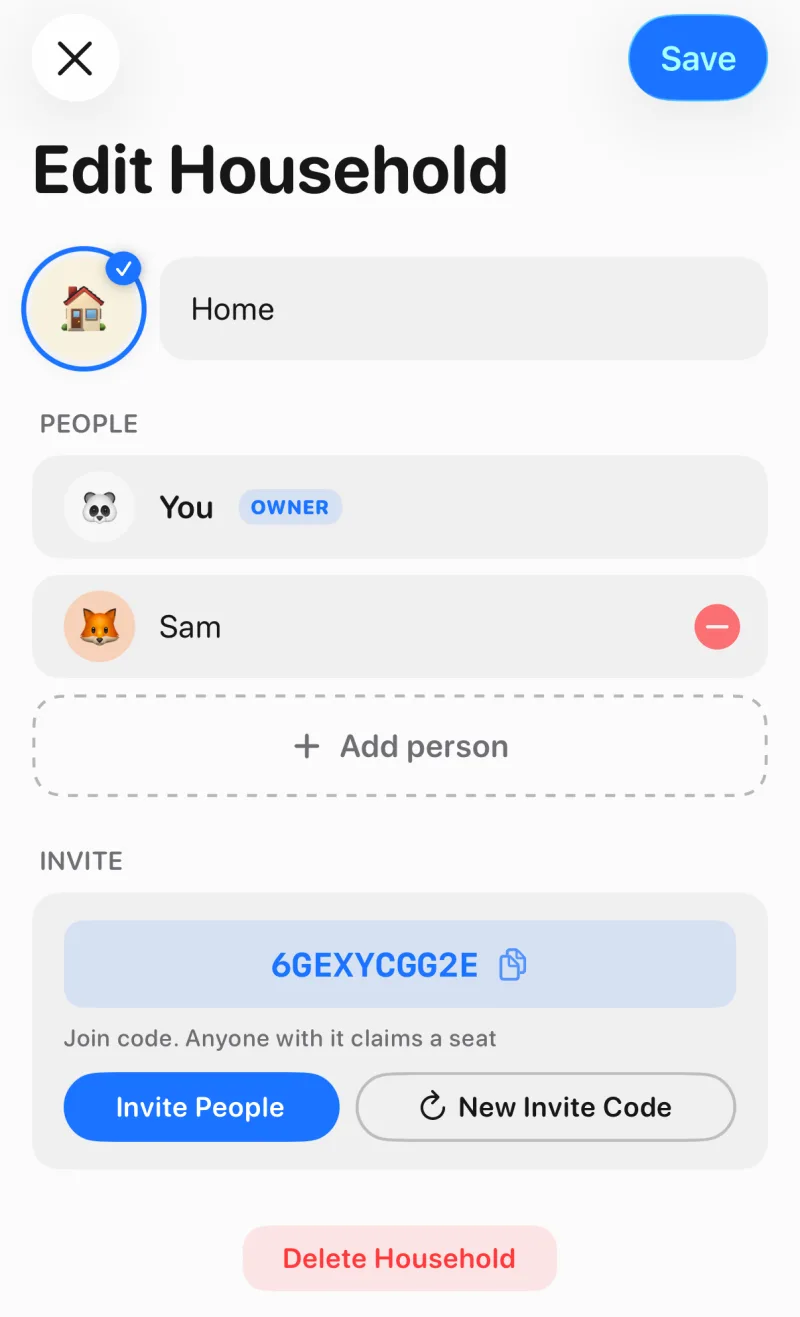
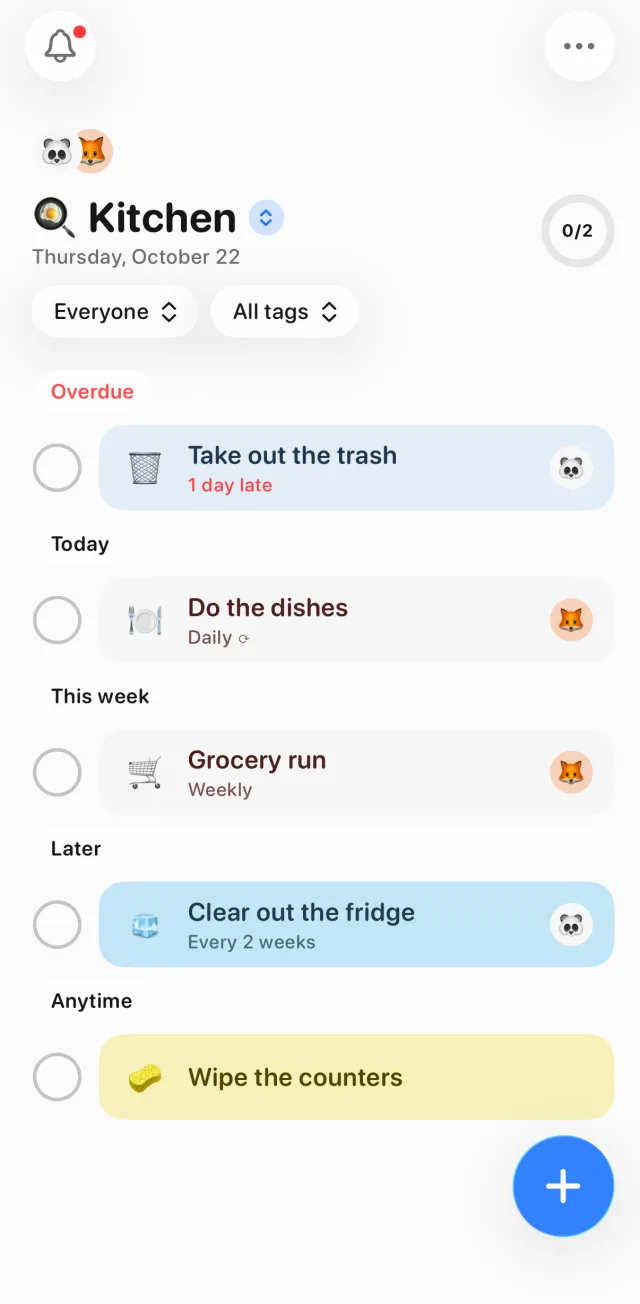
This is where Tidy Up helps. You create a household, share the join code with your partner, and give each chore a schedule (daily, weekly, every 2 weeks and so on) and the people who share it. Each room gets its own list sorted by what's due, so the question "whose turn is it?" answers itself. You can even add your partner by name before they install the app, and they claim that spot when they join.
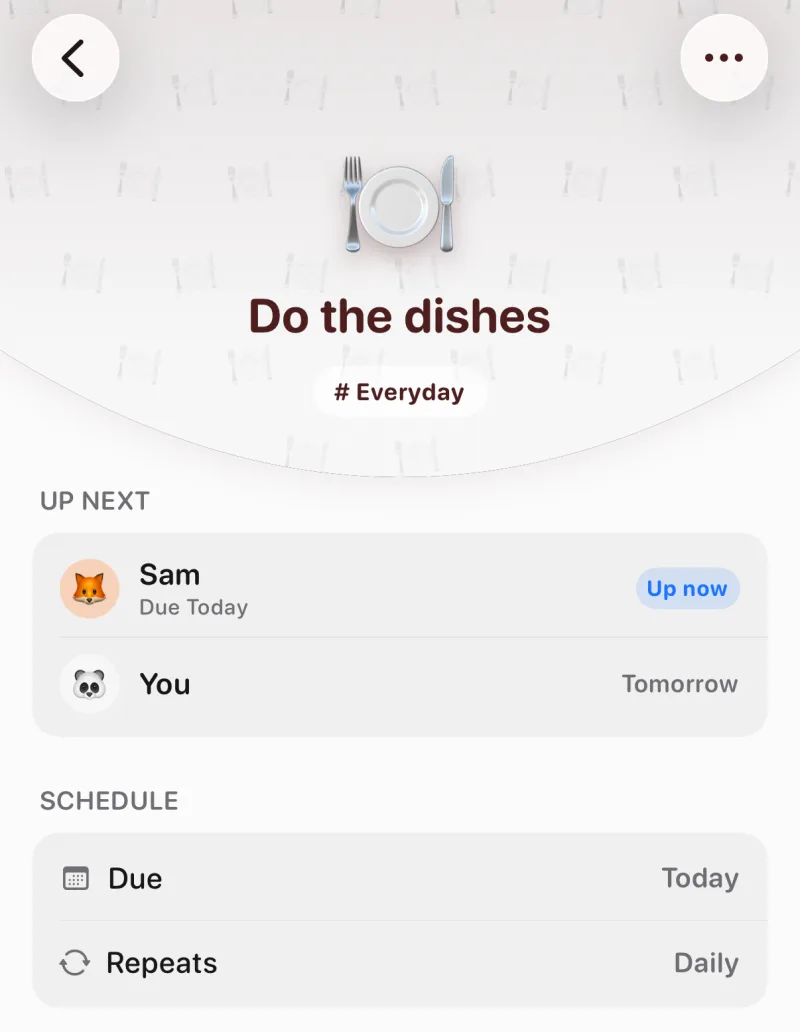
For the jobs nobody wants, turn on rotation. When one of you ticks off the bathroom, the turn moves to the other, and you both see who's up next.
A short note on a chore is a good home for your "done" sentence, like "Bins go out Tuesday night, recycling too", so it's right there when it's your turn.
Step 6: Check in every week
Pick a time, like Sunday after breakfast, and spend ten minutes on two questions: did the split work this week, and does anything need to change next week? A busy week at work, a sick kid or a trip away all change who has time. Swap jobs before anyone starts keeping a silent tally.
It helps to look at the same facts. Tidy Up's Ranking tab shows how many chores each of you completed this week, this month or all time, with the completions listed by day.
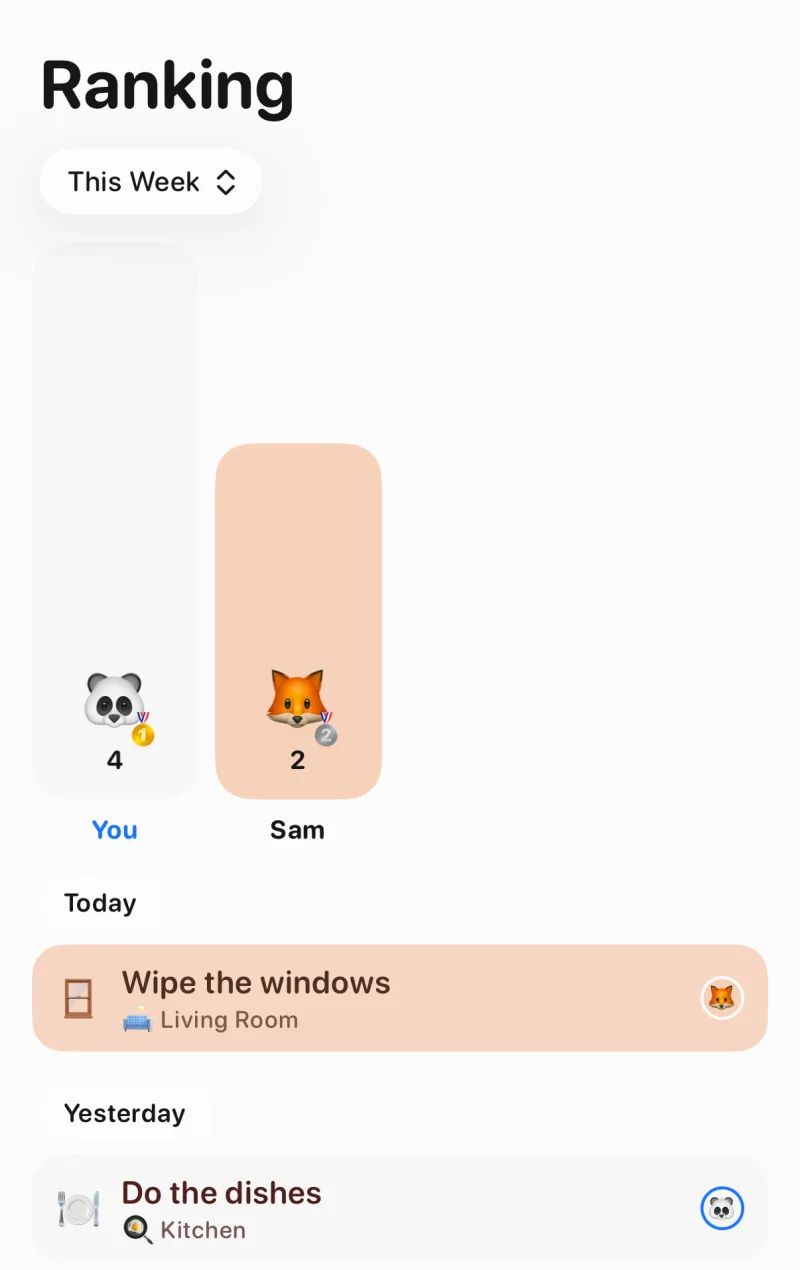
One caution: the ranking counts one point per completed chore, so it isn't a measure of time. Cooking dinner and watering the plants each count once. Use it to spot what's slipping, not to win the week.
Tidy Up is free for unlimited people and chores, with rotation on up to 3 chores per household. Tidy Up+ adds unlimited rotation, more spaces and a morning digest of what's due today.

Tidy Up: chores, schedules and turns
Invite your household with one code, set chores to repeat on a schedule, let them rotate so everyone takes turns, and see who did what in the weekly ranking. Free to start, no ads.

Common questions
What's a fair way to split chores with a partner?
A fair split is one you both agree to after seeing every job, including the planning and remembering. Split by time and preference rather than task count, rotate the jobs neither of you wants, and review it weekly.
Should chores be split 50/50 in a relationship?
Not necessarily by count. Two people can do the same number of chores and spend very different amounts of time on them. If one of you works longer hours or takes on more of the childcare, the housework can lean the other way, as long as you've both agreed to it.
How do we split chores when one of us works from home?
Being home isn't the same as being free. Count the work-from-home partner's working hours like any other job, then split the housework by the time each of you actually has. Quick daytime jobs, like taking in a delivery or starting the laundry, can go to them without handing over the whole house.
What counts as invisible work?
The planning, noticing and remembering behind the chores: meal planning, writing the grocery list, tracking appointments, knowing when supplies are low, remembering birthdays. Put each one on the list as its own job so it gets counted.
How do I bring up the chore split without starting a fight?
Pick a calm moment, not right after a chore was skipped. Start with the list instead of complaints: "Can we write down everything that needs doing and see how it's split?" Looking at the list together makes it a shared problem instead of an accusation.