
Roommate Chore Chart: Templates and a Better Way
The short answer: a roommate chore chart needs four things on it: the shared jobs, how often each one happens, whose turn it is right now, and a place to mark it done. Pick a layout that matches how you split the work (by week, by room, or by how often), agree on it at a short house meeting, and put it somewhere everyone actually looks.
Below are three layouts you can copy, a one-page printable, and an honest look at where to keep the chart, because that's usually what decides whether it's still working a month from now.
Download the printable chart (PDF)
The quick version
- Shared spaces only. Kitchen, bathroom, living room, trash, supplies. Bedrooms stay off the chart.
- Four columns, no more: the job, how often, whose turn, done.
- Pick one layout: by week with names across, by room, or by how often.
- Agree on it together, in one 20-minute house meeting.
- Keep it where everyone sees it, and decide who moves the turn on.
If you haven't decided how to split the work yet, start with our guide to splitting chores with roommates. If you want the rotation patterns in detail (odd numbers, weeks off, missed turns), see how to make a chore rotation schedule. This post is about the chart itself.
What to put on a roommate chore chart
A chart is only as good as what's on it. Keep it to what everyone shares:
- The jobs. Write them as things you can finish, like "clean the bathroom", not "bathroom stuff". If a job causes arguments, add a few words on what done means: "toilet, sink, mirror, shower, floor".
- How often. Daily, weekly, every 2 weeks, monthly. Our house cleaning schedule has a full list if you're unsure how often something really needs doing.
- Whose turn. One name per job, per week. "Everyone" usually means no one.
- A done mark. A tick, a sticker, initials. Without it, nobody can tell whether the bathroom was cleaned on Saturday or just looks fine.
What to leave off: each person's own bedroom, personal laundry, and your own dishes if you've agreed "you use it, you wash it". The chart is for the shared spaces, where the fights happen.
Layout 1: By week, names across
This is the classic roommate chore chart. Names go across the top, week numbers go down, and each cell is that person's job for the week. Everyone moves one job along each week. Here's a three-person version, with week 1 ticked off. "Floors" here means vacuuming the shared rooms plus taking out the trash.
| # | Alex | Jordan | Casey |
|---|---|---|---|
| 1 | Kitchen ✓ | Bathroom ✓ | Floors ✓ |
| 2 | Bathroom | Floors | Kitchen |
| 3 | Floors | Kitchen | Bathroom |
| 4 | Kitchen | Bathroom | Floors |
Good for: three or four people with a simple weekly rotation. It's the easiest layout to read at a glance: find your name, find this week.
Watch out for: it only works if the slots are about equal. "Kitchen" every day is more work than "floors" once a week. The rotation post shows how to weigh and bundle jobs so the slots come out fair.
Layout 2: By room
Here each shared room gets a row, with whose turn it is this week and who's next. Under the chart, list what each room includes, so "kitchen done" means the same thing to everyone.
| Room | This week | Next week | Done |
|---|---|---|---|
| Kitchen | Alex | Jordan | ✓ |
| Bathroom | Jordan | Casey | |
| Living room | Casey | Alex |
What each room includes:
- Kitchen: counters and stove daily, floor and microwave weekly, fridge every 2 weeks.
- Bathroom: toilet, sink, mirror, shower and floor weekly; bath mats every 2 weeks.
- Living room: tidy, dust and vacuum weekly.
- Trash and supplies can go with the lightest room, or get their own row.
Good for: places where rooms are very different in size, and households that like owning a whole space for a week. It's easy to check: the kitchen is either clean or it isn't.
Watch out for: daily jobs inside a room. If Alex has the kitchen all week, Alex is wiping the stove seven days running. Some households keep daily kitchen jobs on a separate daily rotation.
Layout 3: Daily, weekly and monthly jobs
Instead of rooms or weeks, this layout lists every shared job with how often it repeats. It's the one on our printable, and it suits households where jobs rotate at different speeds.
| Job | How often | Whose turn | Done |
|---|---|---|---|
| Counters and stove | Daily | Casey | ✓ |
| Trash and recycling | Weekly | Alex | |
| Clean the bathroom | Weekly | Jordan | ✓ |
| Vacuum and mop | Weekly | Casey | |
| Buy supplies | Weekly | Alex | |
| Clear out the fridge | Every 2 weeks | Jordan | |
| Test smoke alarms | Monthly | Casey |
Good for: catching the jobs that fall through the cracks on a weekly chart, like the fridge, the bath mats and the smoke alarm test.
Watch out for: this is the layout that needs the most updating. Every row has its own "whose turn", and every row moves on at a different time. That's a lot of rubbing out on a whiteboard.
The printable chart
Our one-page printable has a weekly turns grid with four name columns (layout 1) and a list of shared jobs with how often, whose turn and a done box (layout 3), plus three lines for what you agreed at the house meeting. Print it, fill in the names, and stick it on the fridge.
Download the printable chart (PDF)
Where to keep it: fridge, shared doc or app
Each option works for some households. Here's the honest version.
On the fridge or a whiteboard
- Pros: free, everyone walks past it, and ticking a box by hand is satisfying. Nobody needs an account.
- Cons: only visible when you're in the kitchen. Someone has to remember to move the names on each week. A wiped whiteboard takes the whole record with it.
A shared doc or spreadsheet
- Pros: free, easy to edit from anywhere, and you can keep a long history. Good for people who already live in Google Sheets or similar.
- Cons: out of sight unless someone opens it. Moving the turn on is still a manual job, and a spreadsheet won't tell anyone it's their turn. They can be fiddly to edit on a phone.
A chore app everyone shares
- Pros: it's on everyone's phone, the turn can move on by itself when a job is done, and it can tell people when it's their turn or something is late.
- Cons: everyone has to install it and join, which is the hardest part with a reluctant roommate. Some features may cost money. And an app won't fix a roommate who doesn't want to clean; it just makes it visible.
Agree on it at a house meeting
A chart one person makes and sticks up is a chart the others feel no ownership of. Twenty minutes together fixes that. A simple agenda:
- List every shared job and how often it needs doing. Use the printable's list as a starting point.
- Agree what "done" means for the jobs that cause trouble, usually the bathroom and the kitchen.
- Pick the layout and fill in week 1 together.
- Decide who moves the turn on. On paper, name one person and a day, like "Alex updates it Sunday night". This is the step most charts skip.
- Agree what happens when someone's away or a turn gets missed. The rotation post has rules you can borrow.
- Set a check-in date, two or three weeks out, to fix what isn't working.
Why paper charts usually stall
Most roommate chore charts don't fail because people are lazy. They fail for a few boring, fixable reasons:
- Nobody updates the turn. Week 3 arrives, the names haven't moved, and nobody is sure whose week it is. The person who cares most ends up doing it, which is how resentment starts.
- No reminders. A chart can't tell you it's your turn. If you're not in the kitchen on Monday, you won't know.
- It's out of sight. The chart is on the fridge; you're at work, at a friend's or on your phone. By the time you see it, the bins have already gone out without you.
- The record disappears. A wiped whiteboard or a fresh printout erases who did what, so any "I always do the bathroom" argument becomes one word against another.
None of this means paper can't work. It works well for households where someone happily keeps it updated. If that person doesn't exist in your place, it's worth moving the chart somewhere that updates itself.
A chart that moves the turn for you
This is what we built Tidy Up for. Your home is a household, each shared room is a space (Kitchen, Bathroom, Living Room), and each space has its own list of chores. Each chore gets how often it repeats (daily, weekly, every 2 weeks, monthly, every 3 months or yearly) and who's on it: one person, several people, or anyone.
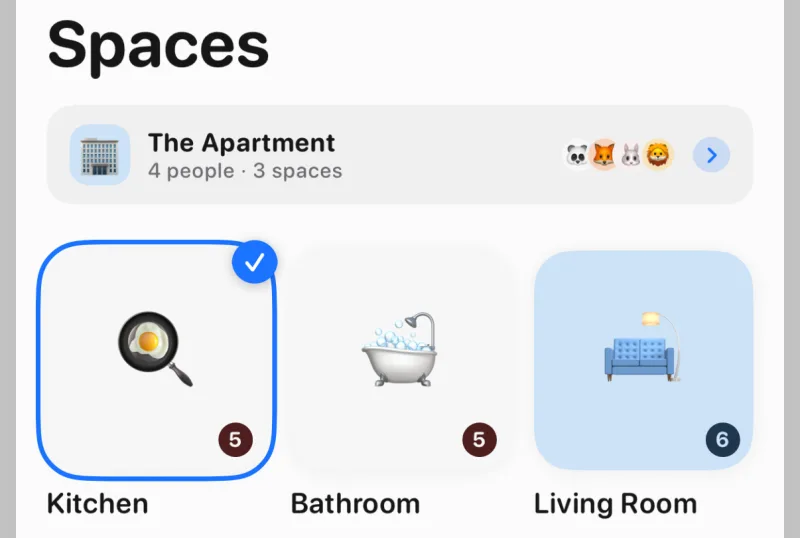
Turn on Rotate for a chore shared by two or more people, and the app handles the step paper charts skip: when someone ticks the chore off, the turn moves to the next person and the due date moves on by one period. Each chore's list shows whose turn it is, so opening the Bathroom space is like reading the by-room chart.
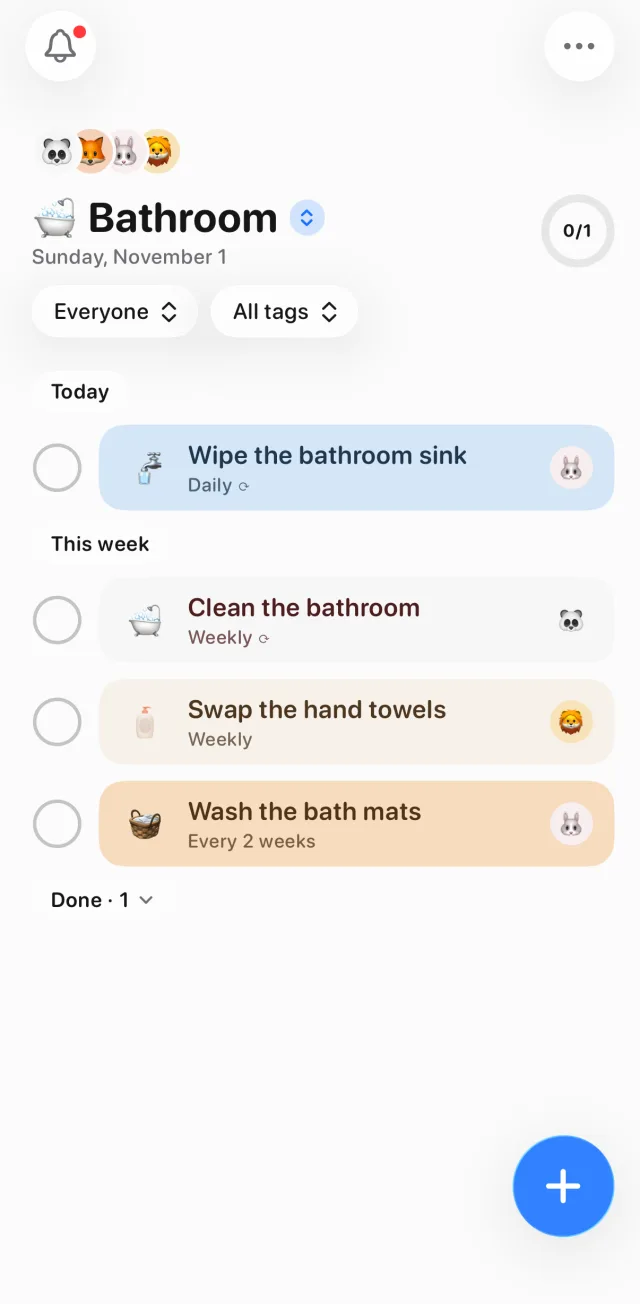
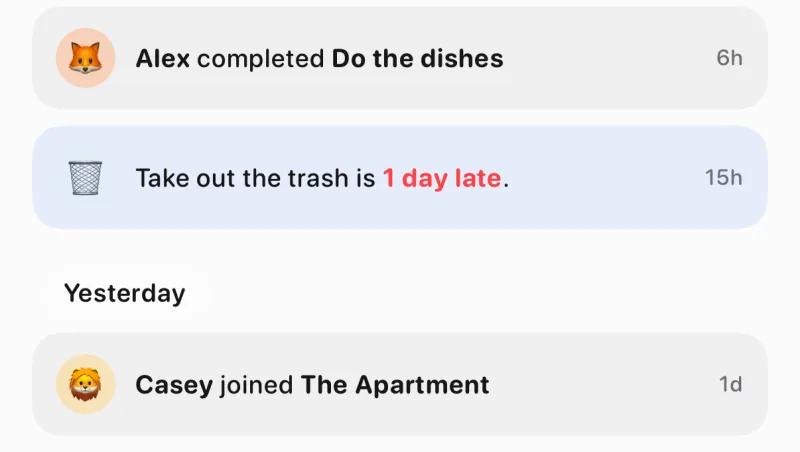
The other two reasons charts stall are covered too. Everyone joins the household with one code, so the chart is on every phone, not just the fridge. And the app sends a notification when a chore rotates to you or someone completes one, while overdue chores show in everyone's inbox with how many days late they are.
A few honest details:
- The free version covers unlimited people and chores, up to 5 spaces you create, and rotation on up to 3 chores per household. That's enough for the big three (say kitchen, bathroom and trash). Tidy Up+ unlocks unlimited rotation and spaces, and adds a morning digest of what's due today at a time you choose.
- The Ranking tab gives one point per completed chore, by week, month or all time. If someone covers a rotating chore for a roommate, the point goes to the person whose turn it was, so settle swaps between you rather than by the ranking.
- There's no skip or away button. For a trip, swap turns with someone, or edit the chore and take that person out until they're back.
If your household is happy with the fridge, keep the fridge. If the chart keeps stalling in week three, this is the fix.

Tidy Up: chores, schedules and turns
Invite your household with one code, set chores to repeat on a schedule, let them rotate so everyone takes turns, and see who did what in the weekly ranking. Free to start, no ads.

Common questions
What should be on a roommate chore chart?
The shared jobs, how often each one happens, whose turn it is, and a place to mark it done. Keep it to shared spaces like the kitchen, bathroom and living room. Each person's bedroom stays off it.
Should roommates use a chore chart by week or by room?
By week with names across is the easiest to read when you have three or four people and roughly equal slots. By room works better when rooms are very different in size, or when people like owning a whole space for a week. Many households combine them: rooms on the chart, daily kitchen jobs on their own rotation.
Is a whiteboard or an app better for a roommate chore chart?
A whiteboard is free and visible in the kitchen, but someone has to update it and it can't remind anyone. An app is on everyone's phone and can move the turn on by itself, but everyone has to install it and join. If your chart keeps stalling because nobody moves the names on, that's a sign to try an app.
How often should a roommate chore chart change?
Most households rotate weekly, with daily jobs like counters on their own faster rotation. Hold a short check-in two or three weeks after you start, and adjust any slot that feels unfair.
How do you get roommates to actually follow the chore chart?
Make it together, agree on what "done" means, and decide who moves the turn on and what happens after a missed turn before anyone needs those rules. A chart everyone agreed to, that everyone can see, does most of the reminding for you.