
How to Make a Chore Rotation Schedule That Actually Rotates
The short answer: group your shared chores into as many equal slots as there are people, give each slot to one person, and move every slot to the next person on a fixed beat, usually once a week. Then decide two rules up front: what moves the turn on (a date, or the chore actually being done) and what happens when someone is away or misses a turn.
Most rotation schedules don't fail on day one. They fail in week three, when someone was away, the bathroom got skipped, and nobody is sure whose turn it is anymore. This guide is about getting past week three, with schedules you can copy for two, three and four people.
The quick version
- List the shared chores and how often each one needs doing.
- Bundle them into one slot per person, so each slot is about the same amount of work.
- Pick a pattern: everything moves weekly, or staggered so not everything changes at once.
- Decide what moves the turn: the calendar, or the chore being done.
- Agree on a rule for missed turns and time away before you need it.
- Check in after one full cycle and fix the slots that feel unfair.
If you haven't split chores with your household before, start with our guide to splitting chores with roommates or with a partner. This post goes deeper on the rotation itself.
Rotation, fixed jobs or a chore wheel?
Rotation isn't always the right answer. Here's how the three common setups compare.
| Setup | How it works | Fits best when |
|---|---|---|
| Rotation | Each job moves to the next person on a schedule | Everyone dislikes the same jobs, or you want everyone to learn every job |
| Fixed jobs | Each person keeps the same jobs | People have strong preferences or very different schedules |
| Chore wheel | A wheel is turned or spun to hand out jobs | You want something visual and a bit of fun, often with kids |
A chore wheel that you turn one notch a week is really a rotation with a nice prop. A wheel you spin is different: the result is random, so the same person can land on the bathroom twice in a row. Some households like that. If fairness is the point, a fixed order is easier to defend.
Many homes end up with a mix: everyone keeps the jobs they don't mind, and only the jobs nobody wants go on the rotation. That's often the easiest version to keep going, because fewer things are moving.
Pick a rotation pattern
Weekly round robin
Every slot moves one person along each week. Person A has the kitchen this week, the bathroom next week, and so on until they're back to the kitchen. It's the simplest pattern to explain and to check: if you know this week's line-up, you know every week's.
Staggered rotation
In a staggered rotation, chores don't all change on the same day. Daily jobs like the dishes can rotate every day, weekly jobs every week, and the fridge clean-out every two weeks. Each chore keeps its own rhythm, so the household never has a confusing "everything changes on Monday" moment, and a bad week for one person only affects one turn, not their whole slot.
The trade-off is that you can't read the whole schedule from one line. You need it written down somewhere everyone can check.
Rotate by room or by task
You can rotate rooms (one person has the kitchen, all of it) or tasks (one person does every floor in the house). Rooms are easier to judge: the kitchen is either clean or it isn't. Tasks suit jobs that need one tool or one trip, like vacuuming the whole place or taking all the trash and recycling down at once.
A common middle ground: rotate the kitchen and bathroom as rooms, and rotate floors and trash as tasks.
Decide what moves the turn
This is the rule most schedules skip, and it's the one that decides whether your rotation survives a missed week.
- The calendar moves it. On Monday the turn passes on, done or not. Simple, but a skipped bathroom just disappears from the record, and the next person inherits the mess.
- Getting it done moves it. The turn passes on only when the chore is finished. A missed turn stays with that person, in plain view, until it's done.
The second way is fairer to the next person in line, and it makes the rotation self-correcting: nobody can fall behind without it showing. It needs one thing the calendar doesn't, though: a shared record of what's done.
Balance heavy and light chores
Cleaning the bathroom and watering the plants are not the same job. If your rotation just moves single chores around, someone gets the bathroom week while someone else gets the plants week, and that only evens out if everyone stays for the whole cycle.
A simple fix is to give each chore a rough weight, like 1 for a quick job, 2 for a medium one and 3 for a big one, and build slots that add up to about the same total.
| Chore | How often | Weight |
|---|---|---|
| Clean the bathroom | Weekly | 3 |
| Kitchen: counters, stove, floor | Weekly | 3 |
| Vacuum the shared rooms | Weekly | 2 |
| Trash and recycling out | Weekly | 1 |
| Buy shared supplies | Weekly | 1 |
| Clear out the fridge | Every 2 weeks | 2 |
From that list, three fair slots could be: bathroom (3), kitchen (3), and vacuum plus trash (3). The supplies run and the fridge can ride along with whichever slot feels lighter in your home. Your weights will differ from ours; the point is that everyone looks at the slots and agrees they're fair.
Example schedules for 2, 3 and 4 people
Copy whichever matches your household and swap in your own chores. A, B, C and D are people.
Two people: staggered, so the big jobs don't stack
| Chore | Week 1 | Week 2 |
|---|---|---|
| Bathroom | A | B |
| Kitchen | B | A |
| Floors | A | B |
| Trash | B | A |
Each week, each person has one big job (bathroom or kitchen) and one smaller one. The every-2-weeks jobs, like the fridge and the bath mats, swap every two weeks: A takes them in weeks 1 and 2, B in weeks 3 and 4. For couples, it's worth reading our post on splitting chores with a partner first: two people often do better splitting by preference and rotating only the jobs neither of you wants.
Three people, four chores: bundle them into three slots
With more chores than people, don't rotate the four chores separately. Bundle them so the number of slots matches the number of people.
| Slot | Week 1 | Week 2 | Week 3 |
|---|---|---|---|
| Bathroom | A | B | C |
| Kitchen | B | C | A |
| Floors + trash | C | A | B |
Every three weeks, everyone has done every slot once. Daily dishes stay out of the rotation: you use it, you wash it.
Four people, three slots: add a week off
With more people than slots, add a rest slot. Each person gets a week off every fourth week, which is a nice thing to look forward to and a natural place to schedule a trip.
- Week 1: Bathroom A, Kitchen B, Floors + trash C, off D
- Week 2: Bathroom B, Kitchen C, Floors + trash D, off A
- Week 3: Bathroom C, Kitchen D, Floors + trash A, off B
- Week 4: Bathroom D, Kitchen A, Floors + trash B, off C
If a week off feels too generous, make the fourth slot a light one instead, like supplies and plants.
The same tricks work for bigger households and for families. Kids can sit in the same rotation as adults for the jobs they can handle; our list of chores for kids by age helps you decide which.
When someone is away or misses a turn
Agree on these before anyone needs them. It's much easier to set a rule when nobody is the one who missed.
- Swap, don't skip. If you'll be away on your bathroom week, trade with someone and take their next turn. Skipping a person shifts everyone, and the order gets muddled fast.
- Cover and owe. If there was no time to swap, whoever covers is owed one turn of the same chore. Write it down.
- Long absences come out of the rotation. For a few weeks away, take that person out and rebalance the slots for the people still home. Put them back when they return.
- A missed turn stays with that person. If the trash didn't go out, it's still theirs to do, not the next person's. That's the "getting it done moves the turn" rule from above.
- Keep consequences agreed and boring, like taking the next turn too. Nobody should be inventing penalties in the moment.
Check in after one full cycle
Pick a date when every person has done every slot once: two weeks for two people, three weeks for three. Spend five minutes on three questions:
- Is any slot clearly heavier than the others?
- Did any chore get skipped more than once?
- Did anyone's schedule change?
Move a chore from the heavy slot to the light one, or change how often something repeats. Our house cleaning schedule has a full list of what to clean daily, weekly and monthly if you're unsure how often a job really needs doing.
Keep the rotation in one shared place
A rotation only works when everyone can see whose turn it is without asking. A whiteboard works until it's wiped, and a spreadsheet works until nobody opens it.
Tidy Up was built for this. You turn on Rotate for a chore, pick who takes part (two or more people), and set how often it repeats. The turn order follows the order people are listed in your household.
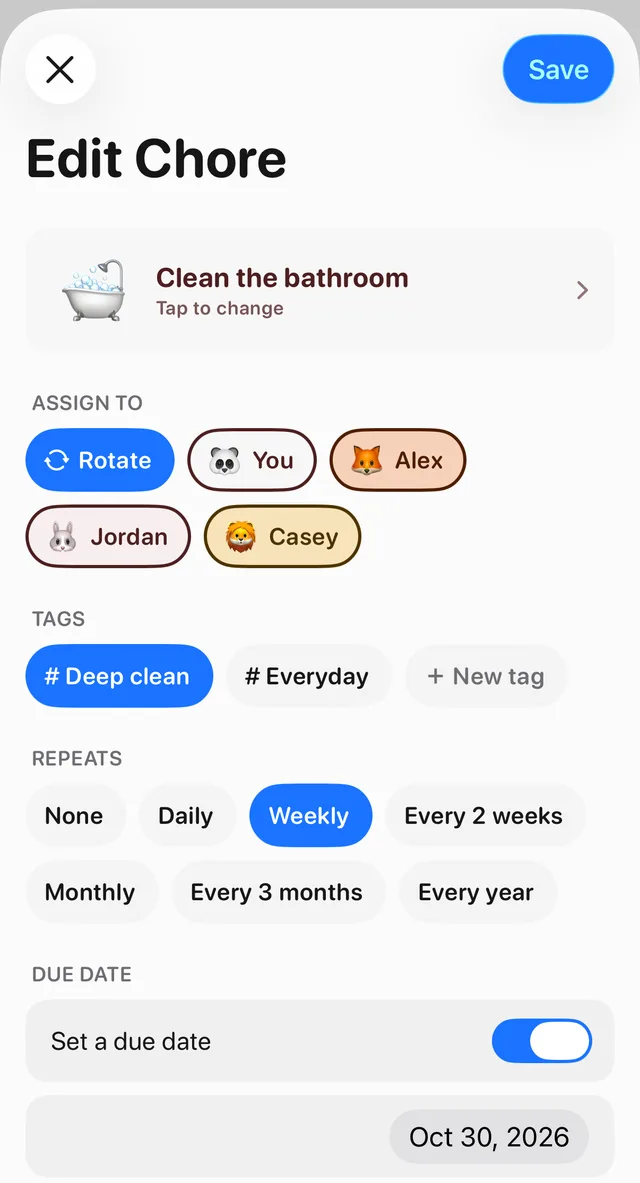
Tidy Up uses the "getting it done moves the turn" rule. When a repeating rotating chore is ticked off, it goes to the next person in line and its due date moves on by one period, from the old due date, so a weekly chore keeps its day of the week even if a turn was done late. Each chore shows an Up next list with the date each person's turn lands, and the next person gets a notification when the chore rotates to them.

If a turn is missed, the chore doesn't jump to the next person. It moves to Overdue, shows how many days late it is, and stays with the person whose turn it is until it's done.

A few details worth knowing:
- Anyone can tick a rotating chore off, and the point in the Ranking goes to the person whose turn it was. Tick it by mistake and you can undo it the same day, which puts the turn back.
- There's no "away" or "skip" button. For a short absence, use the swap rule: whoever covers ticks it off, the turn moves on, and the away person takes the coverer's next turn. Since the point goes to the person whose turn it was, settle the swap between you rather than by the ranking. For a longer absence, edit the chore and take that person out; add them back when they return. Changing who's in a chore starts the order again from the household list, so check Up next afterwards.
- Editing a chore without changing who's in it keeps the turn order, so renaming it or changing the day doesn't reset whose turn it is.
- People who leave the household are skipped automatically.
- Free covers rotation on up to 3 chores per household, with unlimited people and chores. Tidy Up+ unlocks unlimited rotation.

Tidy Up: chores, schedules and turns
Invite your household with one code, set chores to repeat on a schedule, let them rotate so everyone takes turns, and see who did what in the weekly ranking. Free to start, no ads.

Common questions
How often should chores rotate?
Weekly suits most households: long enough to finish a job properly, short enough that nobody is stuck with the bathroom for a month. Daily jobs like dishes can rotate daily, and deep-clean jobs can rotate every two weeks or monthly.
What's the difference between a chore wheel and a chore rotation?
A rotation moves jobs in a fixed order, so you always know who's next. A chore wheel can do the same if you turn it one step at a time, but a wheel you spin hands out jobs at random, which can give one person the same job twice in a row.
How do you rotate chores with 3 people and 4 chores?
Bundle the four chores into three slots of about equal work, for example bathroom, kitchen, and floors plus trash, then rotate the slots weekly. Everyone has done everything after three weeks.
What if someone keeps missing their turn?
Make the missed turn stay with them rather than passing it to the next person, so the gap is visible to everyone. Then talk about it at the check-in. Start with what's in the way, like shifts or exams, before agreeing on a consequence.
Should a chore rotate on a set day or when it's done?
When it's done, if you can track it. A set day is simpler, but a skipped chore then lands on the next person. Rotating on completion keeps each turn with its owner until it's finished.