
Household Chores List for Adults: Everything a Home Needs
The short answer: a complete household chores list for adults covers eight areas: kitchen and food, bathrooms, bedrooms and laundry, living areas, outside and the car, safety and maintenance, money and paperwork, and the people and pets you look after, plus the invisible planning behind all of it. Most lists stop after the first four. The rest is where jobs get forgotten, or quietly land on one person.
Here is the whole list. Copy it, cross out what doesn't apply and add what's missing. It's the first step of any split, because you can't divide fairly what nobody has written down.
A note on the "how often" columns: every frequency is our suggestion for a typical home unless a source is linked next to it. Nobody official says how often to mop. Where a safety or money job has real guidance, we link it.
The list at a glance
| Area | What it covers |
|---|---|
| Kitchen and food | Cooking, dishes, groceries, meal planning |
| Bathrooms | Cleaning, restocking, the medicine cabinet |
| Bedrooms and laundry | Sheets, the full laundry cycle, closets |
| Living areas | Tidying, floors, dusting, plants, mail |
| Outside and the car | Trash, yard, gutters, tires, registration |
| Safety and maintenance | Alarms, filters, heating, repairs |
| Money and paperwork | Bills, budget, insurance, taxes, documents |
| People and pets | Appointments, school, gifts, pet care |
| Invisible work | Noticing, planning, deciding, following up |
If what you want is a day-by-day cleaning routine, that's a different job, and our house cleaning schedule covers it in detail. This list is wider: it's everything it takes to run a home, cleaning being only part of it.
Kitchen and food
Cooking can easily be the biggest job in a house, and it doesn't belong on a cleaning list, so it often gets left off altogether.
| How often | Chores |
|---|---|
| Daily | Cook, or decide who's cooking. Dishes, counters, stove |
| Weekly | Plan meals, write the list, shop and put it away. Take stock of leftovers, mop |
| Every 2 weeks | Wipe out the fridge |
| Monthly | Check the pantry and freezer, clean the dishwasher filter |
| Every 3 months | Clean the oven, descale the kettle or coffee maker |
| Yearly | Pull out the fridge and clean behind it, sort the cabinets |
| When low | Dish soap, sponges, trash bags, foil, staples |
Bathrooms
| How often | Chores |
|---|---|
| Weekly | Toilet, sink, mirror, shower and floor, fresh towels |
| Every 2 weeks | Wash the bath mats |
| Every 3 months | Scrub the grout, wash the shower curtain |
| Yearly | Clear out the medicine cabinet |
| When low | Toilet paper, soap, shampoo, toothpaste, cleaning spray |
The FDA's disposal guide says a drug take-back program is the best way to get rid of most unwanted medicines. It doesn't set an interval; once a year is our pick.
Bedrooms and laundry
Laundry isn't one chore. It's sorting, washing, drying, folding and putting away, and the last step is the one that tends to get left in a basket.
| How often | Chores |
|---|---|
| Daily | Clear the floor and nightstand, make the bed if you like |
| Weekly | Change the sheets, do the laundry start to finish, dust, vacuum |
| Every 3 months | Wash pillows and duvet, sort out clothes that no longer fit |
| Twice a year | Swap seasonal clothes and bedding |
| Yearly | Clean under the beds, clear one closet |
Living areas
| How often | Chores |
|---|---|
| Daily | A 10-minute tidy, sort the mail, shoes and bags back in place |
| Weekly | Vacuum and mop, dust, water the plants |
| Monthly | Wipe light switches and handles, vacuum the sofa |
| Every 3 months | Wash the curtains, clean the vents |
| Yearly | Wash the windows, clear out the storage space |
Outside and the car
Apartment dwellers can skip the yard, but someone still has to take the trash down.
| How often | Chores |
|---|---|
| Weekly | Trash and recycling out on collection day, sweep the entry |
| Every 2 weeks | Mow the lawn in season, weed, wash the car |
| Every 3 months | Clean out the car, tidy the garage or balcony |
| Yearly | Clean the gutters, service the mower, renew the registration |
| By season | Rake leaves, shovel snow, store the hoses |
For the car, NHTSA says to check tire pressure, including the spare, and tread at least once a month, and to follow your owner's manual on rotating tires. Oil changes and servicing also go by the manual, not by us.
Safety and maintenance
This is the section where official guidance exists, so here are the sources. All of them are US agencies; if you live elsewhere, check your local equivalent.
Monthly
- Test smoke alarms. The US Fire Administration says every month.
- Test carbon monoxide alarms. The EPA says monthly.
- Inspect, clean or change the HVAC filter. ENERGY STAR says once a month.
- Test GFCI outlets, the ones with test and reset buttons. The CPSC's electrical checklist says once a month.
Every 3 months
- Drain a quart from a tank water heater to clear sediment, per the Department of Energy's Energy Saver guide. Check your heater's manual first.
Twice a year
- Check carbon monoxide alarm batteries when the clocks change, per the CDC.
- Inspect electrical cords and products for damage, per the same CPSC checklist.
Yearly
- Service the heating system, water heater and any gas, oil or coal appliances, using a qualified technician, per the CDC.
- Have chimneys cleaned and inspected by a professional, per the US Fire Administration.
- Replace 9-volt smoke alarm batteries, per the same USFA smoke alarm page. Sealed 10-year alarms don't need this, but every smoke alarm gets replaced after 10 years.
- Update your emergency kit. Ready.gov says to rethink your needs every year and replace expired items.
- Practice your fire escape plan. The US Fire Administration explains how but sets no interval, so once a year is our suggestion.
As it comes up
Fix the drip, replace the bulb, book the repair and be home for it. Renting? Your job is often just reporting the problem to the landlord, but somebody has to be the one who reports it.
Money and paperwork
None of this gets dirty, so none of it makes a cleaning list. It still takes time, and it tends to stay with whoever started doing it.
| How often | Chores |
|---|---|
| Weekly | Open the mail, check what's due |
| Monthly | Pay bills, go over the budget, check bank and card statements |
| Every 3 months | Cancel subscriptions you've stopped using |
| Yearly | File taxes, compare phone and internet plans, update the home inventory, check passport and ID dates |
Two yearly jobs have a source. The FTC says it's important to check your credit reports at least once a year, for free at AnnualCreditReport.com. And NAIC, the US insurance regulators' association, says to check with your agent at least once a year that your homeowners policy still gives you enough coverage.
People and pets
The most easily forgotten section, because it doesn't live in any room.
- Health: book doctor, dentist and eye appointments, at whatever interval your own clinicians recommend. Refill prescriptions before they run out.
- Kids: school forms, lunches, activities, childcare, sick-day plans, clothes they've outgrown. Older kids can take on some of the housework; see our chores for kids by age.
- Family and friends: remember birthdays, buy gifts and cards, plan holidays and visits, check in on aging parents.
- Pets: daily feeding and walks, weekly litter or cage cleaning, vet visits and medication on your vet's schedule, and a sitter when you travel.
- Calendar: a weekly look at who needs to be where, and who's driving.
The invisible work: put it on the list too
Every job above has a hidden job behind it. Allison Daminger, in a 2019 American Sociological Review study of 35 couples, calls this cognitive labor and breaks it into four parts: anticipating needs, identifying options, making decisions and monitoring progress. She found it's often invisible even to the people doing it, and a frequent source of conflict.
In practice, it looks like this:
| The visible chore | The job behind it |
|---|---|
| Cook dinner | Decide what, check what's in the house |
| Grocery run | Notice what's low, write the list |
| Take a child to the dentist | Remember it's due, find a time, book it |
| Plumber fixes the leak | Find one, get a quote, check the fix |
| Give a birthday gift | Remember the date, choose it, buy it |
If one person does the remembering and the other does the task when asked, the task is shared but the job isn't. So write "plan the week's meals" and "keep track of what we're low on" as their own lines, with their own names on them.
What to do with the list
- Cross out what doesn't apply and add what's specific to your home.
- Mark who does each job today. Do this honestly and without commentary. It's often the most useful 20 minutes of the whole exercise.
- Split it. Living with a partner? Our guide to splitting chores with your partner splits by time and preference, not by count. Sharing a place? See how to split chores with roommates, where only the shared jobs count.
- Rotate what nobody wants, with a chore rotation schedule.
- Put it somewhere that reminds you. A list in a drawer works once.
Keep the list somewhere it comes back on its own
Nobody forgets the dishes. People forget the yearly jobs, because a year is a long time to remember anything.
Tidy Up keeps the list in one shared place. A household is made of spaces, and a space doesn't have to be a room. On the free plan, you can create up to 5 per household, which is enough for this setup.
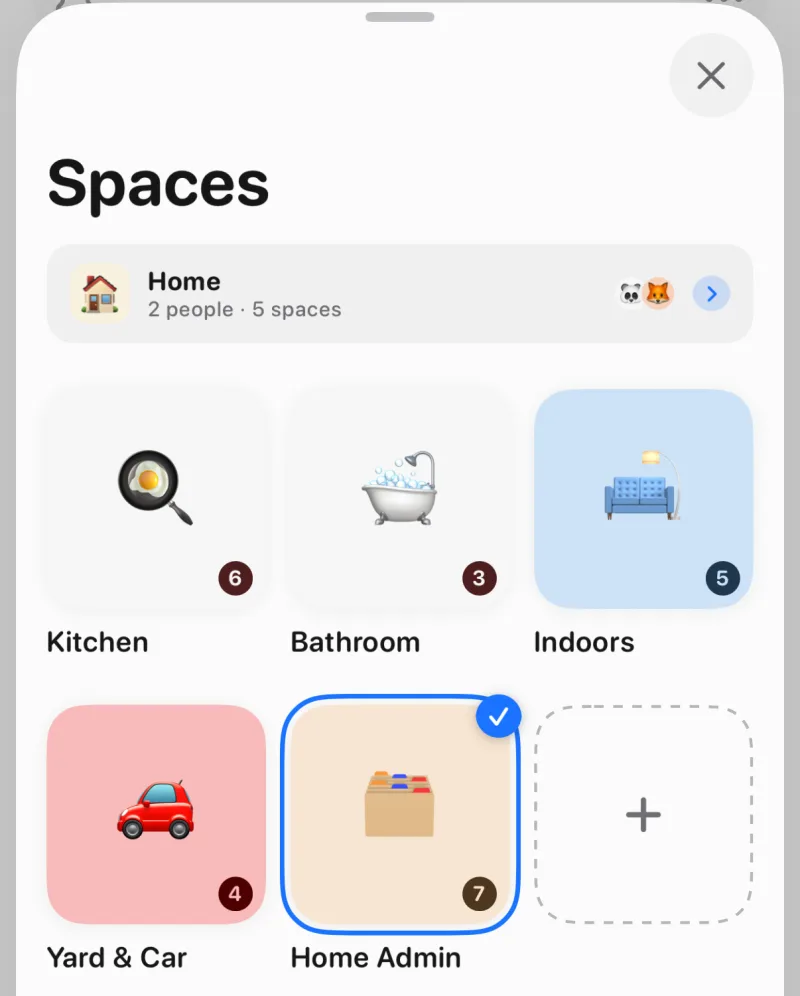
Each chore can repeat daily, weekly, every 2 weeks, monthly, every 3 months or every year. Tick one off and it moves to its next due date, so the yearly insurance check returns next year without anyone remembering it.
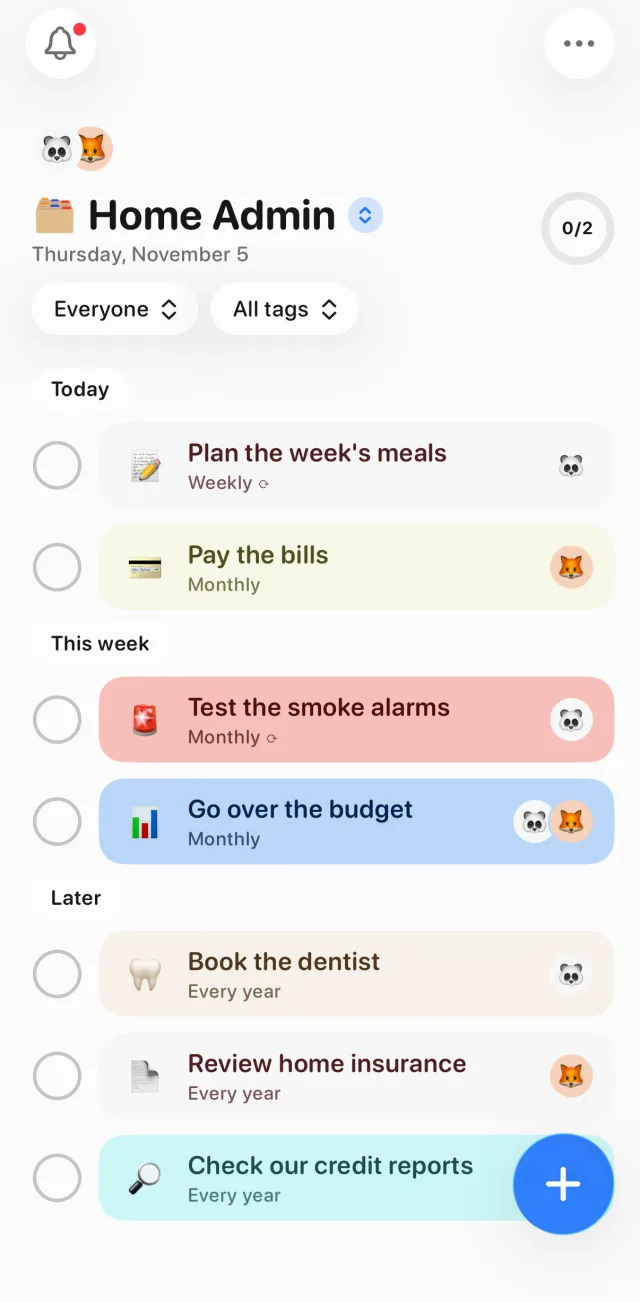
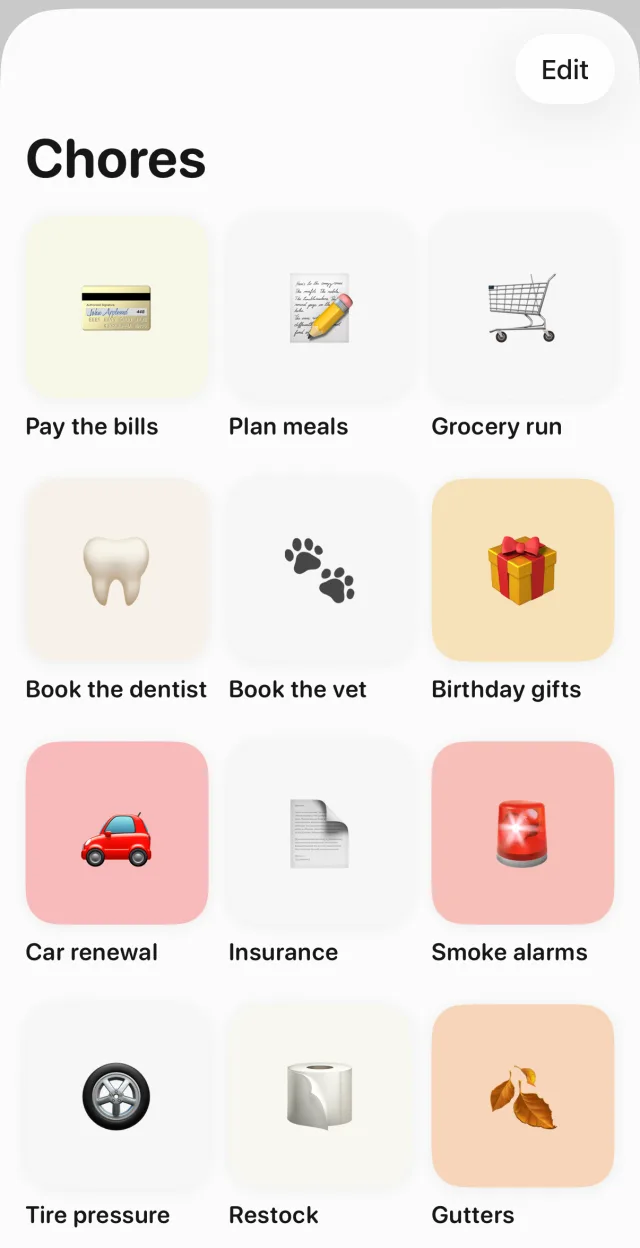
Save the chores you add to more than one place in the chore library (Settings, then Chores), and they're one tap away from any space. It starts empty, so you fill it with your own list.
Share the household's 10-character join code and everyone sees the same list, with each chore assigned to one person, several or anyone. Rotation hands the worst jobs to the next person each time. One limit, so you know: there's no twice-a-year option, so use two yearly chores six months apart.
Tidy Up is free for unlimited people and chores, with up to 5 spaces you create per household and rotation on up to 3 chores. Tidy Up+ adds unlimited spaces and rotation and a morning digest of what's due today.

Tidy Up: chores, schedules and turns
Invite your household with one code, set chores to repeat on a schedule, let them rotate so everyone takes turns, and see who did what in the weekly ranking. Free to start, no ads.

Common questions
What are the basic household chores every adult should know?
Cooking a few meals, grocery shopping, dishes, laundry start to finish, cleaning a bathroom, vacuuming and mopping, taking out the trash, paying bills, booking appointments, and testing the smoke alarms. If you can do those, you can run a home.
What counts as a household chore?
Any work that keeps the home and the people in it running, paid or not. That includes cleaning, cooking, shopping, repairs, yard work, pet care, bills and paperwork, plus the planning behind them.
How many chores should an adult do each day?
There's no standard number, and counting chores can mislead, because cooking dinner and watering a plant aren't the same size. Estimate the time instead, and aim for a split that everyone in the home agrees is fair.
What chores do people forget most?
There's no official ranking. Our guess is the rare ones and the ones with no room attached: gutters, the water heater, alarm tests, insurance reviews, renewing documents, and anything that depends on someone remembering. Those are the jobs worth scheduling first.
What's the difference between a chores list and a cleaning schedule?
A chores list is everything that needs doing, including money, errands and appointments. A cleaning schedule is the part of it that keeps the house clean, arranged by day and week. Start with the list, then use a house cleaning schedule for the cleaning part.