
How to Get Kids to Do Chores Without Nagging
The short answer: give each chore a fixed spot in the day, put it on a list your child can see, spell out exactly what "done" looks like, do it together until they can do it alone, and then follow through calmly instead of reminding again. The list and the routine do the reminding, so you don't have to.
That isn't just a parenting hack. The American Academy of Pediatrics puts it plainly in its guide to chores: "Badgering or scolding a child is not an effective method to get them to accept more responsibility; rewarding successes and providing encouragement is always much more effective."
If you're still working out which chores suit which age, start with our chores for kids by age list. This post is about the next part: getting those chores done without saying "I've asked you three times" every evening.
The quick version
- Anchor every chore to a routine: after breakfast, before bath, before screens.
- Put the list where they can see it, so you point at the list instead of repeating it.
- Say exactly what done means, as a statement, one step at a time.
- Do it together first, then step back a little each week.
- One reminder, then follow through, calmly and every time.
- Notice the effort, especially when they start without being asked.
- Keep the load small and add one new chore at a time.
- Check in once a week as a family, and change what isn't working.
Why the nagging loop starts
Most kids procrastinate sometimes. The AAP says so directly: as children take on more responsibilities, they "will likely have periods when they procrastinate or need reminders. Most kids do." That part is normal.
The loop starts when the reminder becomes the system. If the chore only happens after the third "Did you feed the cat?", the reminder is the real deadline, and you've become the family alarm clock. Everything below is about handing that job to something else: a routine, a list, and a clear rule about what happens next.
1. Anchor every chore to a routine
A chore with no set time is a chore you have to remember for them. A chore that always happens at the same point in the day starts to happen on its own.
The AAP suggests you "build structure and routines into your family life" and "encourage them to do their chores at the same time each day", because it gives your child a greater chance of remembering. The American Academy of Child and Adolescent Psychiatry (AACAP) says the same: establish regular routines, like "Clean up before dinner."
Pick anchors that already happen every day:
| Anchor | Chore that goes with it |
|---|---|
| After breakfast | Plate and cup to the sink |
| After school | Empty the lunchbox, hang up the coat |
| Before dinner | Set the table |
| Before bath | Toys back in the bins |
| Before screens | Feed the pet, make the bed |
Once the anchor is set, the request changes from "Go clean your room" to "It's before bath. What's on your list?" Same chore, much less arguing.
2. Make the list visible
The AAP recommends a chore chart or checklist and explains why: "It acts as a visual reminder to keep all members of the family on task. It also provides each child with a sense of accomplishment with each completed task." It also says star charts or chore lists posted in your child's room or on the refrigerator "should clearly show what your expectations are."
A visible list changes who does the remembering. You stop reciting chores and start pointing: "Check the list." For kids who can't read yet, a picture next to each chore works: a toothbrush, a bed, a fish.
Put the adults' jobs on the same list. The AACAP's advice to "be a good role model" is easier to follow when kids can see that someone takes out the trash and cleans the bathroom too.
3. Say exactly what "done" means
"Clean your room" means something different to a 7 year old than it does to you. The AACAP's first tip is to "set clear and reasonable expectations" and "let your child know exactly what needs to be done", with the example "please take out the trash from the kitchen after breakfast."
The CDC's tips for giving directions, written for parents of toddlers and preschoolers, add two things that work at any age:
- Make it a statement, not a question. The CDC advises you to "be specific in your directions and make it a statement rather than asking if your child wants to do something", because "questions give your child the option to refuse." "Toys in the bins, please" beats "Do you want to tidy up?"
- One step at a time for younger kids. The CDC says "it's best to give one instruction at a time."
For bigger jobs, write the finish line down once and keep it with the chore:
- Make your bed: duvet pulled up, pillow on top, pajamas under the pillow.
- Tidy your room: toys in the bins, clothes in the hamper, books on the shelf, floor clear.
- Feed the cat: one scoop, fresh water, bowl back on the mat.
Now "done" isn't up for debate, and you're checking against the list, not against your mood.
4. Do it together first
Kids learn a chore by doing it with you, not by being told about it. The AACAP suggests you "make longer jobs fun and cooperative" and "use songs or games if you can", and points out that "it may seem faster to do the chores yourself, however, helping your child to learn these will be helpful in the long run."
Start side by side, then do less each week: you fold, they match socks; then they fold and you check; then it's theirs. The chores by age post has a simple show, do together, watch sequence for teaching a new job.
Expect it to be imperfect for a while. The AAP's words: "Just don't expect perfection; this is a learning process." The AACAP adds that if you need to loop back and help them finish, "it may mean they are still learning."
5. One reminder, then follow through
This is the step that actually ends the nagging. Give one clear reminder, and then do what you said you would, every time.
The CDC's directions page lays out the same pattern: give the direction, check whether your child did it, and follow through. On consequences it says "for consequences to work, you need to follow through with the consequences each time", and suggests asking yourself first "if you have the time and energy to follow through." It also warns that "it will take some time for your child to learn that you mean what you say."
For school-age kids who keep skipping chores, the AAP says that when a child "makes a choice not to complete their chores and other responsibilities, consider consequences", for example revoking "certain privileges or special activities", and reminds parents that "electronic devices and screen time are privileges, not rights."
In practice that can sound like this:
- The anchor: "Chores come before screens."
- The one reminder: "Your list isn't done yet. Screens are after the fish is fed."
- The follow-through: no screens until it's done, said calmly, with no lecture.
Keep the consequence small, related and something you'll really do. A consequence you won't enforce trains kids to wait you out, which is the nagging loop again.
6. Notice the effort
The AAP says honest praise "can be the most effective way of motivating your child", and says to praise "your child's effort in each task, not the outcome." It singles out one moment worth catching: initiating tasks "on their own without a reminder."
That's the behavior you want more of, so say so when it happens: "You fed the fish before I even asked." The AACAP's example is simple: "Great job on the toys!"
Stickers, star charts and allowances are a family decision. The AAP mentions "tangible rewards like allowances and stickers tied to completed chores" as something you may consider, and the AACAP suggests a star chart or reward system with specific goals. Neither is required for any of the steps above.
7. Keep the load small
A long list is a recipe for nagging. The AAP says that with a school-age child, especially one who hasn't had chores before, you should "introduce one new task at a time; a long list can be overwhelming," and warns that kids given too much "may feel overwhelmed and resist taking on any responsibilities at all."
It also asks parents to "factor your child's style in your expectations": some kids "drift away in the middle of chores," others struggle to get organized or to switch activities. A child who drifts may do better with shorter jobs; a child who struggles to switch may need a five-minute heads-up before the anchor.
If you're choosing a first chore, here are examples the AACAP and AAP give for each age. They are a starting point, not a test your child has to pass.
| Age | Try one of these | Source |
|---|---|---|
| 2 to 3 | Put toys away, put groceries away | AACAP |
| 4 to 5 | Help feed pets, make their bed, help clear the table | AACAP |
| 5 to 7 | Set and clear the table, put dirty clothes in the hamper | AAP |
| 8 to 10 | Vacuum, put away their own laundry | AAP |
| 11 to 12 | Clean the kitchen, change bedsheets, do and fold laundry | AAP |
| 12 and up | Wash the car, help with younger siblings | AACAP |
The full lists, with safety notes for things like mowing and cleaning products, are in chores for kids by age.
8. Check in once a week
The AAP suggests regular family meetings "to review your child's progress", to ask for their ideas about chores, and to create new or modified "contracts" for what's expected. Ten minutes on Sunday is enough: what went well, what kept getting skipped, and whether anything should change hands.
Letting kids choose between two chores, or trade one they hate for one they don't mind, makes the list feel like theirs. If two kids share a job, taking turns is usually fairer than splitting it; our chore rotation guide covers how to set up turns that keep moving.
Is it worth the effort?
The AACAP says "research suggests there are benefits to including chores in a child's routine as early as age 3," and that "children who do chores may exhibit higher self-esteem, be more responsible, and be better equipped to deal with frustration, adversity, and delayed gratification." The AAP says helping keep the home running "boosts a child's self-esteem."
One 2022 study of 207 children aged 5 to 13, based on parent questionnaires, found that self-care and family-care chores (like making a meal for yourself or for someone else) "significantly predicted working memory and inhibition." The authors call for more research, so treat it as a promising link, not proof that chores make kids smarter.
When it's still a battle
If none of this helps, look for the reason. The AACAP suggests trying "to understand the reasons why" a child is unable or unwilling, and says struggles that continue or get worse "may be a sign of other conflicts or issues that need attention." Both the AAP and the AACAP suggest talking to your pediatrician. The AAP notes the pediatrician may simply reassure you that your child is behaving in an age-appropriate way, and may be more concerned if similar problems show up at school too.
Let the app hold the list
The whole method rests on a list that's always visible and always up to date. A paper chart on the fridge works until it's out of date. Tidy Up is a shared chore list for the household that keeps itself current.
You create a household and add your kids by name, with an emoji and a color each. They don't need a phone or an account to be on the list. Give them a space of their own, like Kids' Room, and add their chores there, each one assigned to one child and set to repeat daily, weekly or on another schedule.
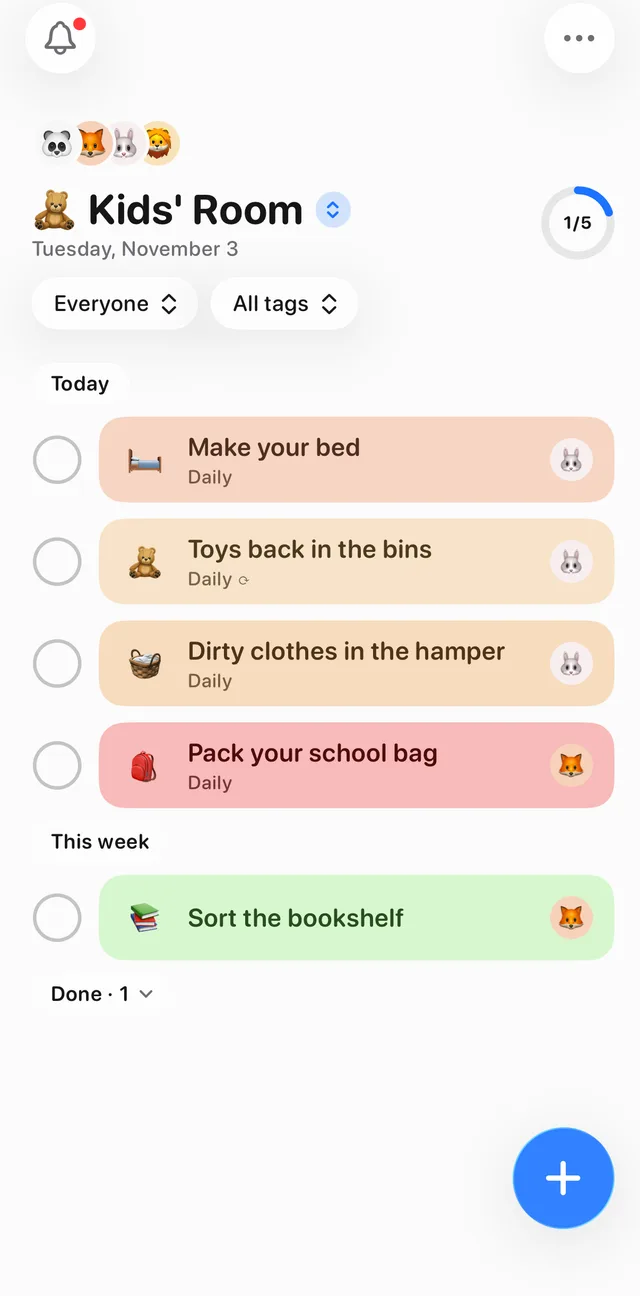
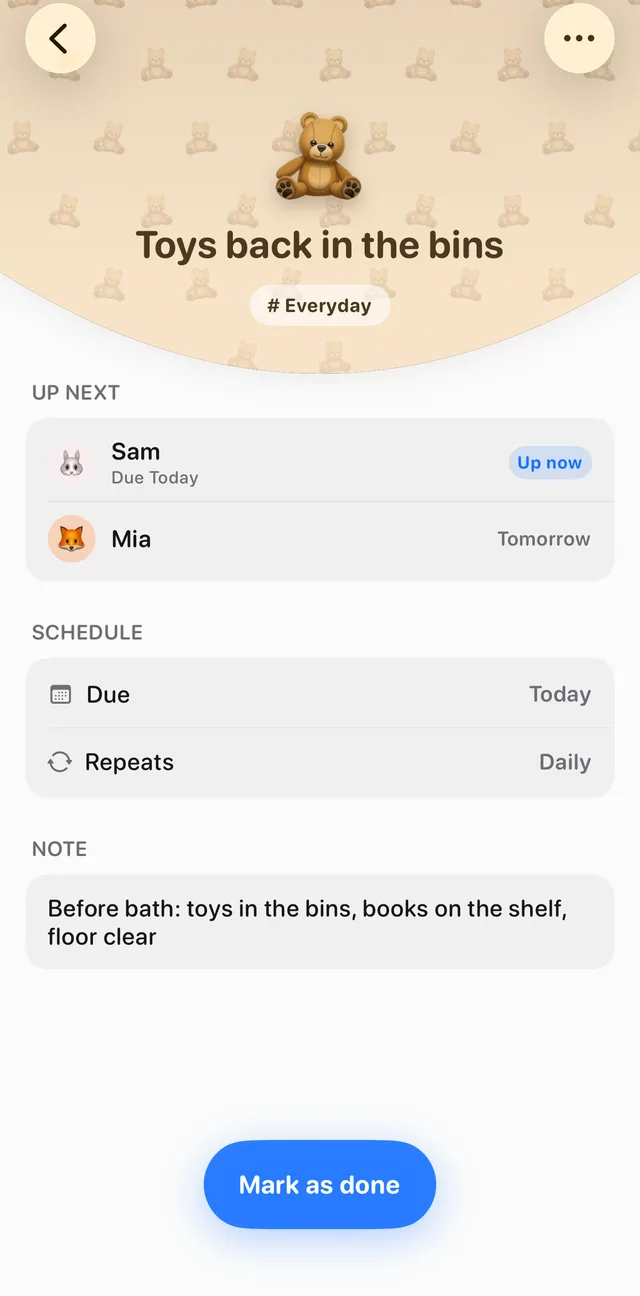
Every chore can carry a note, which is a good home for the "what done means" line from step 3. When it's the kids' turn to share a job, rotation hands it to the next child each time it's ticked off, and the chore shows who's up now and who's next.
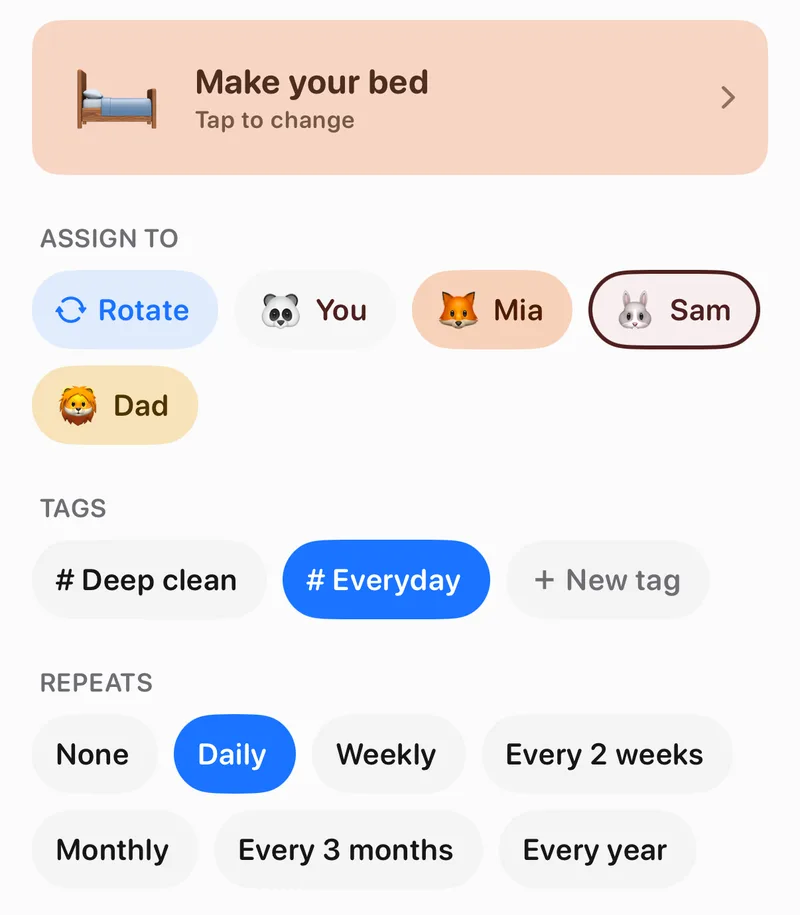
How it works for kids without a phone: you tick their chores off from your phone when they're done. A chore assigned only to that child, or a rotating chore on their turn, counts for them in the Ranking tab, which shows how many chores each person finished this week, this month or all time. A chore assigned to several kids without rotation counts for whoever ticks it off, so give each child their own copy (one "Make your bed" for each). On a rotating chore, the point goes to the child whose turn it was, even if a sibling covered for them; there's no skip or swap button, so agree on swaps out loud.
An older kid with their own iPhone can join with the household's 10-character code and claim the spot you made for them (joining needs a sign-in with Apple or Google). From then on they get a notification when a chore is assigned to them or rotates to them, and overdue chores show in the in-app inbox for everyone, which beats you announcing them.
Tidy Up doesn't do allowances, points to spend or rewards. If your family uses them, that part stays between you and your kids.
It's free for unlimited people and chores, with up to 5 spaces you create per household and rotation on up to 3 chores. Tidy Up+ adds unlimited spaces and rotation and a morning digest of what's due today, at a time you pick. If the grown-up side of the house needs sorting too, see our guides to a house cleaning schedule and splitting chores with a partner.

Tidy Up: chores, schedules and turns
Invite your household with one code, set chores to repeat on a schedule, let them rotate so everyone takes turns, and see who did what in the weekly ranking. Free to start, no ads.

Common questions
How do I get my child to do chores without reminding them?
Tie each chore to a fixed point in the day (after breakfast, before bath), keep a list they can see, and agree on what done means. Then give one reminder and follow through. The AAP recommends routines, a visible chart and encouragement over badgering or scolding.
Should I take away screen time if chores aren't done?
The AAP says to consider consequences, such as revoking certain privileges or special activities, when a child chooses not to do their chores, and calls screen time a privilege, not a right. Keep it calm and consistent; the CDC says consequences only work if you follow through each time.
Should kids get paid for chores?
That's a family decision. The AAP mentions allowances and stickers as one option alongside honest praise, and the AACAP suggests a star chart or reward system. The steps above work with or without them.
How many chores should a child have?
There's no official number. The AAP says to introduce one new task at a time and to avoid overloading kids, so start with one or two daily jobs and add more as each becomes routine.
At what age should kids start doing chores?
The AACAP says research suggests benefits from including chores in a child's routine as early as age 3, and lists putting toys and groceries away for 2 and 3 year olds. The AAP says most preschool age kids can start pitching in with simple household tasks.