
Deep Cleaning Checklist: Room by Room
The short answer: a deep clean is everything your weekly clean skips. Inside the oven and fridge, behind and under the furniture, the tops of cabinets, grout, vents, baseboards, mattresses and windows. Work one room at a time, top to bottom and dry before wet: dust high surfaces first, then wipe, then vacuum, and mop last on your way out of the room.
Below is the full checklist for each room, then the order to work in, a two-day weekend plan, how to split it in a shared home, and how often each job really needs doing. Copy it, cross out what you don't have and keep the rest.
Deep cleaning vs regular cleaning
Regular cleaning keeps the surfaces you see and touch every day under control. Deep cleaning gets the places you don't see: inside appliances, behind and under them, above eye level and in the corners.
| Regular | Deep | |
|---|---|---|
| What | Surfaces you see | Inside, behind, under, above |
| How often | Daily to weekly | Monthly to yearly |
| Time | Minutes a day | Hours per room |
| Example | Wipe the stovetop | Degrease the range hood |
If you're looking for the everyday side, our house cleaning schedule lays out what to do daily and weekly. This post is only the deep part.
Before you start: supplies and safety
You don't need much. A step stool, microfiber cloths, a vacuum with a crevice tool and a brush head, a mop, an old toothbrush for grout and tracks, rubber gloves, trash bags, an all-purpose cleaner, and whatever your oven or tile actually needs.
A few rules matter more than which spray you buy:
- Never mix bleach with ammonia or any other cleaner. That's the CDC's wording in its guide to cleaning with bleach, which also says to read and follow the safety instructions on the bleach label. Check the labels before you use two products in the same room or bucket.
- Don't mix products at all. The CDC's page on cleaning and disinfecting your home says plainly not to mix products or chemicals with each other. One product, rinse, then the next.
- Air the room out. The same page says to ensure good ventilation when using products indoors, with fans or open windows and doors. Open a window in the bathroom before you start on the shower, not after.
- Follow the label and wear gloves. The CDC says to read and follow label directions, wear the recommended protective equipment such as gloves or goggles, and store chemicals out of reach of children and pets.
- Clean before you disinfect. Dirt gets in the way of disinfectants, so the CDC's order is soap and water first, then a disinfectant only where you need one.
The order to work in
The order saves you from cleaning the same spot twice.
- Declutter first. Clear counters, floors and surfaces so you're cleaning the room, not moving stuff around it.
- Top to bottom. Ceiling corners, light fixtures, fan blades and the tops of cabinets come first. Whatever falls lands on surfaces you haven't cleaned yet.
- Dry before wet. Dust and vacuum before you wipe or mop. Wet dust turns into streaks and mud.
- Back to front. Start at the far side of the room and finish at the door, so you never walk across a wet floor.
- Soak first, scrub later. Put the oven racks, shower head or range hood filter to soak at the start of the session, then go back to them when they've done the hard work themselves.
- Floors last. Vacuum, then mop, then leave.
The room-by-room checklist
The frequency next to each job is our suggestion for a typical home. Nobody official sets how often to clean a range hood. Where something depends on your appliance, the manual wins.
Kitchen
The biggest deep clean in most homes, so start it early in the day.
- Wipe the tops of the cabinets and the fridge (every 3 months)
- Degrease the range hood and soak its filter (every 3 months)
- Clean the oven and the racks (every 3 months, more if you roast a lot)
- Empty the fridge, wash the shelves and drawers, wipe the seals (monthly)
- Clean the dishwasher filter, following the manual (monthly)
- Wipe cabinet doors, handles and the backsplash (monthly)
- Descale the kettle or coffee maker (every 3 months)
- Clear out the pantry and check the dates (every 3 months)
- Pull out the fridge and stove and clean behind and under them (yearly)
- Empty the cabinets and wipe them inside (yearly)
- Scrub the sink and the drain, then the floor, edges first (monthly)
Bathroom
Open the window or run the fan before you spray anything.
- Dust the vent fan cover and the light fixture (every 3 months)
- Descale the shower head and faucets (every 3 months)
- Scrub the grout and the caulk lines (every 3 months)
- Wash the shower curtain and liner, or clean the glass door and its track (every 3 months)
- Clean behind and around the base of the toilet (monthly)
- Clear out the cabinet under the sink and the medicine cabinet (yearly)
- Wash the bath mats (every 2 weeks)
- Wipe the baseboards and the door, then mop (monthly)
Bedrooms
- Dust the ceiling fan, the light fixture and the top of the wardrobe (every 3 months)
- Vacuum the mattress, then flip or rotate it if the manufacturer recommends it (every 3 months)
- Wash the pillows, duvet and mattress protector, if the care labels allow (every 3 months)
- Vacuum under the bed and behind the nightstands (monthly)
- Wipe the headboard, light switches and door handles (monthly)
- Clear out one closet or drawer of clothes that no longer fit (twice a year)
- Wash the curtains or dust the blinds slat by slat (every 3 months)
Living areas
- Dust the ceiling corners, fan blades, picture frames and the tops of bookshelves (every 3 months)
- Vacuum the vents and the air return covers (every 3 months)
- Vacuum the sofa, lift the cushions and clean underneath (monthly)
- Move the furniture and vacuum where it stood (every 3 months)
- Wipe the TV and the electronics with a dry cloth, cables included (monthly)
- Wipe the baseboards and the door frames (every 3 months)
- Wash the windows inside, the sills and the tracks (twice a year)
- Spot clean or deep clean the rug (yearly)
Entry
The entry collects whatever comes in on shoes, so it's a small job with a big payoff.
- Wipe the front door inside and out, the handle and the doorbell (monthly)
- Shake out or wash the doormat (monthly)
- Empty the shoe rack and the coat closet, wipe the shelves and toss what nobody wears (every 3 months)
- Wash the light fixture and the switch plates (every 3 months)
- Sweep the porch or the hallway outside your door (monthly)
Laundry
- Clean the washing machine, following the manual (monthly)
- Wipe the washer door seal and the detergent drawer (monthly)
- Clean behind the dryer and check the vent (every 3 months)
- Wipe the tops of the machines and the shelves (monthly)
- Clear out the cupboard of half-empty bottles (every 3 months)
The dryer vent is a safety job, not just a tidy one. Our house cleaning schedule has what the US Fire Administration says to check.
A weekend deep cleaning plan
Doing the whole house in one day is how deep cleans end at 9 p.m. with the bathroom half done. Two days is realistic for most homes, and doing just the rooms on day one is still a win.
| When | Rooms | Why then |
|---|---|---|
| Saturday morning | Kitchen | Longest job, most energy |
| Saturday afternoon | Bathrooms | Wet work, window open |
| Sunday morning | Bedrooms, laundry | Sheets wash while you dust |
| Sunday afternoon | Living areas, entry | Floors last, then done |
A few things that make it easier:
- Start the soaks and the loads first. Oven racks in the tub, range hood filter in hot soapy water, pillows in the washer. They work while you do something else.
- One room fully done beats four half done. Finish each room through to the floor before you move on.
Short on a full weekend? Pick one room per weekend and the whole house is done in about a month.
How to split a deep clean in a shared home
A deep clean goes much faster with more people, but only if everyone knows their part before Saturday.
- Split by room. Each person takes a room from top to floor. Simple, and nobody waits on anyone else.
- Split by job type. One person does all the high dusting and vacuuming, the other follows with the wet work. This follows the dry-before-wet order naturally.
- Rotate the jobs nobody wants. The oven, the grout, behind the fridge. Whoever did it last time skips it this time. Our chore rotation schedule has patterns for 2, 3 and 4 people.
- Count the time, not the jobs. Cleaning the oven and wiping a light switch are both "one chore". Balance by how long they take.
If you haven't split the regular chores yet, start with our household chores list for adults and the guides to splitting chores with a partner or with roommates. The deep clean fits on top.
How often to deep clean
There's no official rule for how often to deep clean a home. A rhythm that works for most:
| How often | Deep cleaning jobs |
|---|---|
| Monthly | Fridge, dishwasher filter, washer, cabinet doors, under the beds and the sofa |
| Every 3 months | Oven, range hood, grout, shower head, vents, pillows, behind the dryer |
| Twice a year | Windows, closets, seasonal swap |
| Yearly | Behind the big appliances, inside the cabinets, the rug, the medicine cabinet |
Spread like this, no single weekend has to do everything. Each month you do the monthly round plus a few of the bigger jobs, and the yearly ones get a date of their own.
Put the deep clean on repeat
The hard part of deep cleaning isn't the scrubbing. It's remembering that the range hood filter was last cleaned in spring.
Tidy Up handles that part well. Each room is a space with its own chores, and each chore can repeat monthly, every 3 months or every year, alongside daily, weekly and every 2 weeks. Tick one off and it moves to its next due date by itself, so the oven comes back in three months without anyone keeping track.
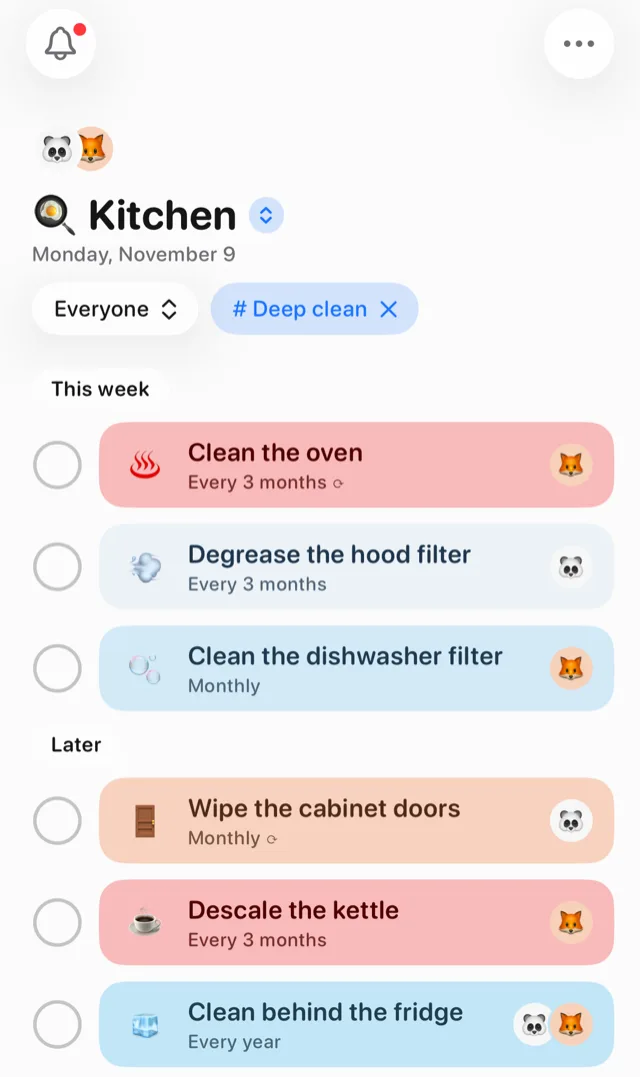
Tag your deep cleaning jobs and filter each room's list by that tag, so the everyday chores step aside and you see only the deep clean, sorted into This week and Later.
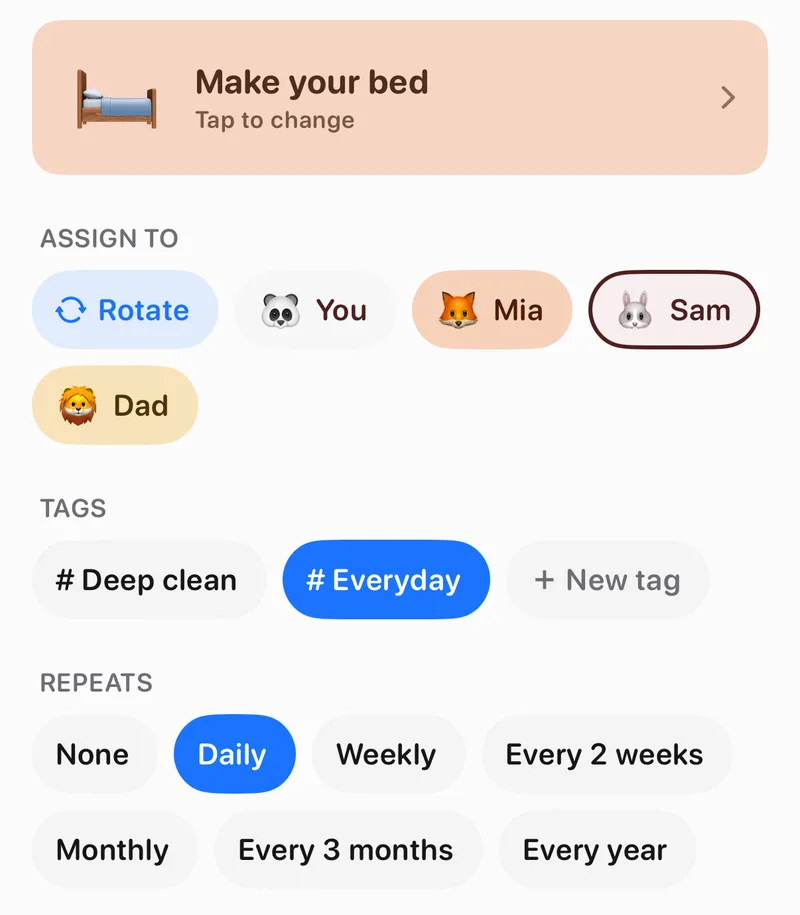
Setting it up is one form per chore: pick who it goes to, add a tag, and choose how often it repeats.
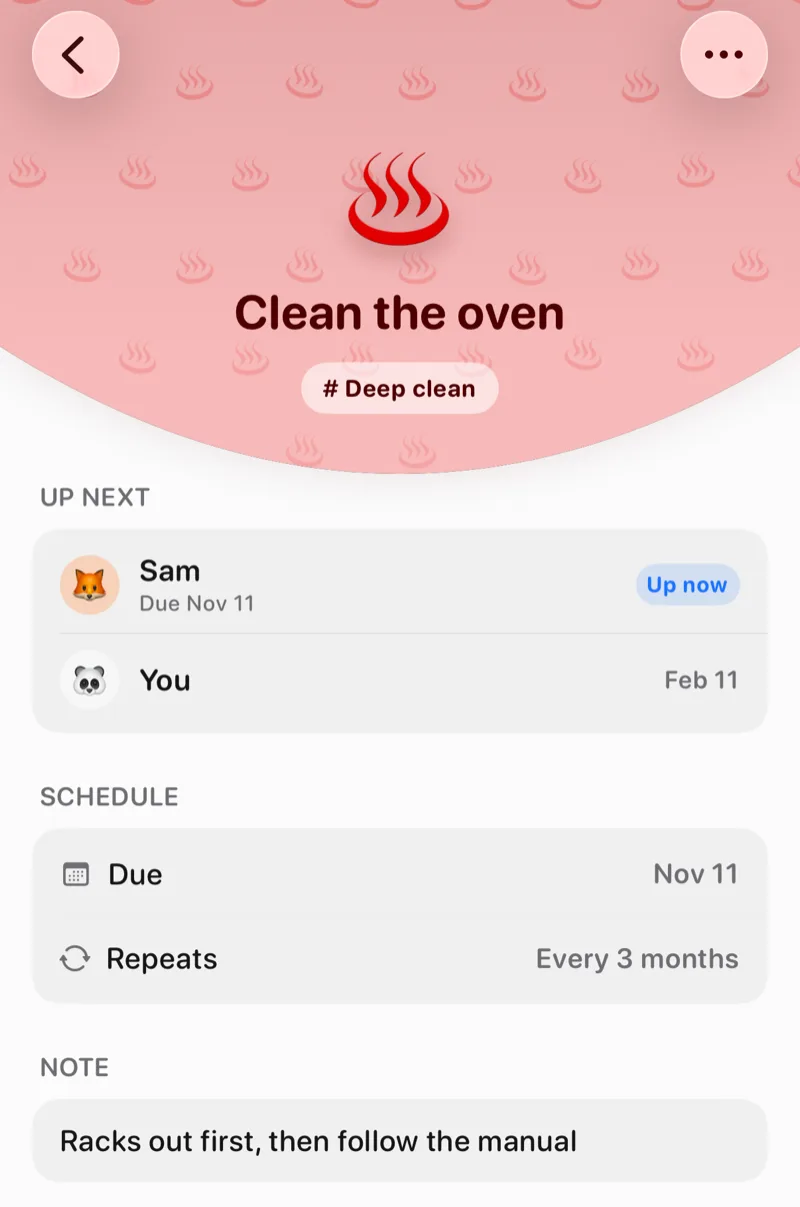
In a shared home, invite everyone with the household's 10-character join code. A chore can go to one person, several, or anyone. For the jobs nobody wants, turn on rotation: when someone ticks off the oven, the turn moves to the next person, and everyone sees the queue. A note on the chore keeps the method in one place.
The free plan covers unlimited people and chores, up to 5 spaces you create per household and rotation on up to 3 chores, so save rotation for the worst deep cleaning jobs. Tidy Up+ adds unlimited spaces and rotation and a morning digest of what's due today. One honest limit: there's no twice-a-year option, so set two yearly chores six months apart for the windows.

Tidy Up: chores, schedules and turns
Invite your household with one code, set chores to repeat on a schedule, let them rotate so everyone takes turns, and see who did what in the weekly ranking. Free to start, no ads.

Common questions
What is included in a deep clean?
Everything a regular clean skips: inside and behind the appliances, the tops of cabinets and door frames, baseboards, vents, grout, light fixtures, under the furniture, mattresses, pillows, curtains and windows. Regular cleaning keeps a home usable; a deep clean resets it.
What order should you deep clean a house in?
Room by room, starting with the hardest one, usually the kitchen. Inside each room, work top to bottom and dry before wet: dust, then wipe, then vacuum, then mop your way out the door.
How often should you deep clean your house?
There's no official rule. Doing a few deep jobs every month, a bigger round every 3 months and a yearly round for behind the appliances and inside the cabinets keeps the house in good shape without one giant clean.