
How to Get Roommates to Clean Up After Themselves
The short answer: before you say anything, check whether the thing that bothers you was ever agreed. Then name one specific problem (the dishes, the bathroom, the trash), not the person. Raise it face to face with a short script, agree on a standard and on who does what by when, and put that somewhere everyone can see so the list does the reminding. If one roommate still doesn't do their share, follow up once on the facts, rebalance the jobs, and only then look at a paid cleaner, outside help, or a move.
This guide walks through those steps in order, with words you can borrow. It assumes your roommate is a reasonable person who sees the mess differently than you do, because most of the time that's what is going on.
The quick version
- Check what was actually agreed. If nothing was, start there, not with a complaint.
- Name the problem, not the person. "Dishes are staying in the sink for days", not "you're a slob".
- Raise it in person, early, with a three-line script.
- Agree a visible standard: what done means, who does it, by when.
- Let the system remind people, so nobody has to be the house nag.
- If it still isn't working: follow up once, rebalance, then consider a cleaner, outside help, or a move.
Step 1: Check what was actually agreed
Most roommates never sat down and agreed how clean the place should be. Each person brought a standard from home and assumed it was the normal one. So "they never clean" often means "they clean less often than I would, and we never talked about it".
Ask yourself three questions before the conversation:
- Did we ever agree on this, out loud or in writing? If not, your roommate isn't breaking a rule. They don't know there is one.
- Is it a shared space? The kitchen, bathroom, living room and trash are fair game. Their own bedroom is their business unless it's causing smells or pests.
- Is my standard the agreed one, or just mine? Wanting the stove wiped after every meal is fine to ask for. It isn't a failing on their part that they didn't guess it.
If you've never split the work at all, do that first. Our guide to splitting chores with roommates covers listing the jobs and choosing a fair split. This post is about the conversation, and what to do when a split exists and someone isn't keeping to it.
Step 2: Name the specific problem, not the person
"You never clean" is a statement about someone's character, and people defend their character. "The trash has been full since Thursday" is a statement about the trash, and trash can be fixed.
Pick the one or two things that bother you most and put them in plain facts:
- Instead of "you're so messy", try "dishes are staying in the sink for two or three days".
- Instead of "you never help", try "I've cleaned the bathroom the last three times".
- Instead of "you're disgusting", try "the trash was overflowing when I got home on Friday".
Stick to one or two issues. A list of nine complaints sounds like an attack even if every item on it is true.
Step 3: Raise it early, in person, with a short script
UCLA's Residential Life office has a roommate guide that explains why timing matters: "The pattern that turns small issues into big ones is silence. You let it slide, it happens again, and by the time you say something you are angry and your roommate is blindsided."
The University of Colorado Boulder's tips for living with roommates add that it should be a real conversation: "Using texts, social media or sticky notes to bring up problems can often lead to misunderstandings or make the situation worse." Pick a calm moment when nobody is rushing out the door or half asleep, and not the moment you find the mess.
UCLA's method is four short steps: say what you noticed without judgment, say how it affected you, suggest something specific, then listen. For a cleaning problem, that sounds like this:
- What you noticed: "The dishes have been sitting in the sink for a few days at a time."
- How it affects you: "I end up washing them before I can cook, and I'm getting annoyed about it."
- Something specific: "Could we agree that dishes are washed by the end of the night?"
- Then listen: "Does that work for you, or is something getting in the way?"
That last line matters. As the UCLA guide puts it, "Your roommate gets a say too, and the fix you land on together will hold better than one you dictate." You may learn they work late shifts, that they thought you didn't mind, or that something you do bothers them just as much.
If it's the whole house: a 15-minute meeting
When more than one person or more than one chore is involved, don't have the same talk three times. Call a short house meeting and keep it about the home, not about one person.
- What's working. Start with what is getting done. It sets the tone.
- What isn't. Each person names one thing, as a fact about a room or a job.
- What "done" means for those jobs. Write it down.
- Who does what, by when. Names and days, not "we'll all try harder".
- What happens after a missed turn. Agree on it now, while nobody is the one who missed.
- A check-in date two weeks out.
Let everyone raise something, including about you. A meeting where one person gets told off isn't a meeting, and it won't stick.
Step 4: Agree a visible standard, and who does what by when
A talk that ends with "okay, I'll try to do more" changes nothing, because nobody knows what "more" is. End with three things written down for each problem job:
- What done means. "Bathroom: toilet, sink, mirror, shower and floor." "Trash: bag out, new bag in."
- Who. One name per job per week. "Everyone" usually means no one.
- By when. "Dishes by the end of the night." "Bathroom by Sunday evening." "Trash out Tuesday night."
Then put it where everyone sees it. If you want a paper version, our roommate chore chart post has layouts and a printable. If the jobs nobody wants should move around, the chore rotation schedule post shows how to set up turns for 2, 3 or 4 people.
Agree on the result, not the method. If the bathroom is clean by Sunday evening, it doesn't matter whether it happened at 7 a.m. or at midnight.
Step 5: Make the system do the reminding
The reason nagging feels bad on both sides is that one person has become the reminder. They have to notice, remember whose turn it is, and say something, and the other person hears a roommate telling them what to do.
Move that job off a person and onto the system:
- Whose turn it is should be answerable without asking. If people have to ask you, you're still the reminder.
- A missed job should stay visible until it's done, with the name still on it. It shouldn't quietly pass to the next person or vanish on Monday.
- Done should be marked, so "I did it on Saturday" isn't one person's word against another's.
- Agree one neutral nudge. For example: "If something is two days late, anyone can say 'the bathroom's still open' and nobody takes it personally."
When the list shows that the bathroom is three days late, nobody has to announce it. You're both looking at the same fact.
Step 6: When one roommate still doesn't do their share
Give the new agreement two full weeks. If one person is still skipping, work through these in order.
Follow up once, on the facts
Go back to the script from step 3, with the agreement as the starting point: "We agreed the bathroom gets done by Sunday. It's been missed twice. What's going on?" Ask the question and wait for the answer. One calm follow-up is not nagging. Five hints and a slammed cupboard are.
Rebalance before you escalate
If the answer is a real obstacle, change the split instead of repeating the request:
- Swap jobs. Someone who can't face the bathroom may be fine doing all the trash, recycling and supply runs.
- Change the timing. A roommate on night shifts may never manage "by the end of the night" but can manage "before you leave for work".
- Fewer, fixed jobs. Some people do better owning two jobs every week than taking a turn at everything.
- Trade work for something else, like covering the cleaning supplies, if everyone thinks that's fair.
Split a paid cleaner
If the household can afford it, a cleaner for the shared spaces every few weeks takes the biggest jobs out of the argument. Agree on the split first. Some households split it evenly; others agree that a roommate who opts out of the cleaning rotation pays a larger share. Daily jobs like dishes and trash still need owners.
Bring in outside help, only where it applies
- In a dorm or university housing, ask your RA. UCLA's guide describes mediation as "a structured conversation with a neutral staff member" and is honest about the order: "We will always ask whether you have talked to your roommate first." CU Boulder says its Student Conduct and Conflict Resolution office helps students with roommate conflicts whether they live on or off campus, so check whether your school has something similar.
- In a private rental, a landlord isn't a referee for the dishes. It only makes sense to involve them when the mess has become a property problem, like pests, damage, or trash rules the building enforces. Read your lease first, because a complaint about the state of the apartment can affect everyone living there, including you.
Know when to plan your exit
If you've agreed a clear standard, followed up, offered a different split, and nothing has changed, the problem may be that you and this roommate want different homes. That's a compatibility problem, not a moral one. Check when the lease ends and what it says about leaving early or replacing a tenant, and plan around that date instead of spending another year resentful.
One exception to all of the above: if you feel unsafe, skip the steps. As UCLA's guide says, that is "a different situation entirely", and the right move is to contact the people responsible for your housing right away.
How Tidy Up helps with the follow-through
Tidy Up is a shared chore app for households, and it's built around steps 4 and 5: a standard everyone can see, and a list that does the reminding. Everyone joins the household with one code. Each shared room is a space with its own chores, and each chore has a schedule, the people on it, and an optional note.
The note is a good home for what you agreed "done" means. Turn on rotation for a chore and it takes turns: when someone ticks it off, it moves to the next person, and the chore shows the whole queue with the date each turn lands.
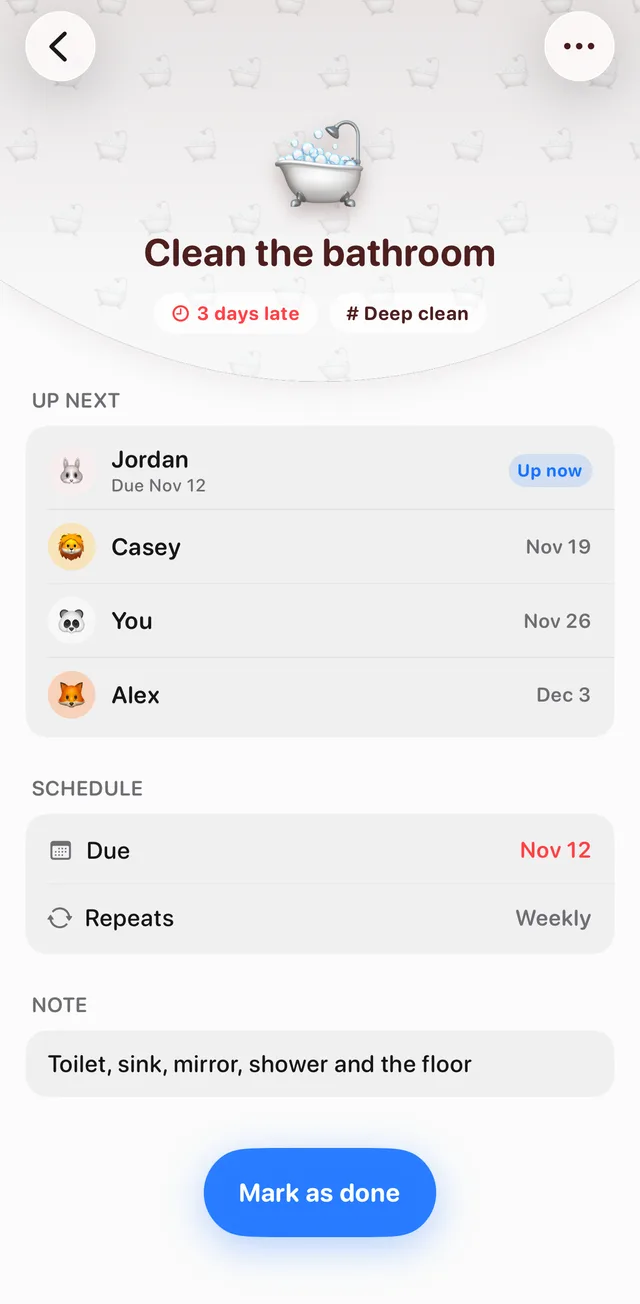
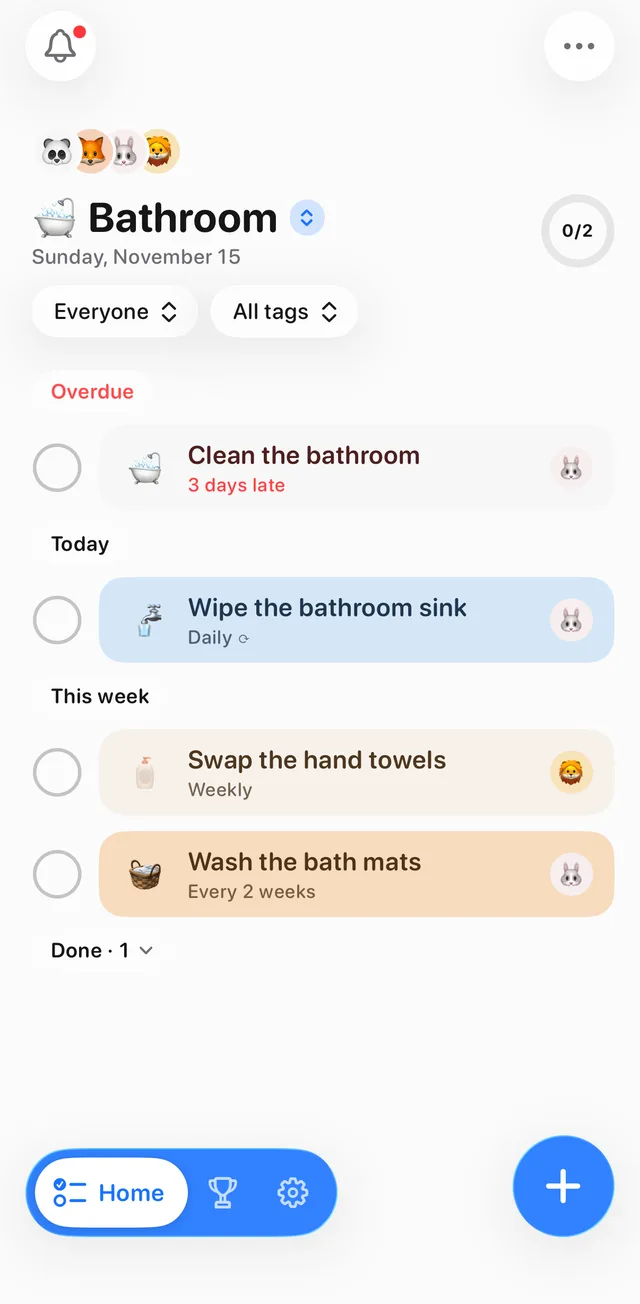
A missed turn doesn't pass to the next person. The chore moves to the Overdue section at the top of the room's list, shows how many days late it is, and stays with the person whose turn it is until it's ticked off.
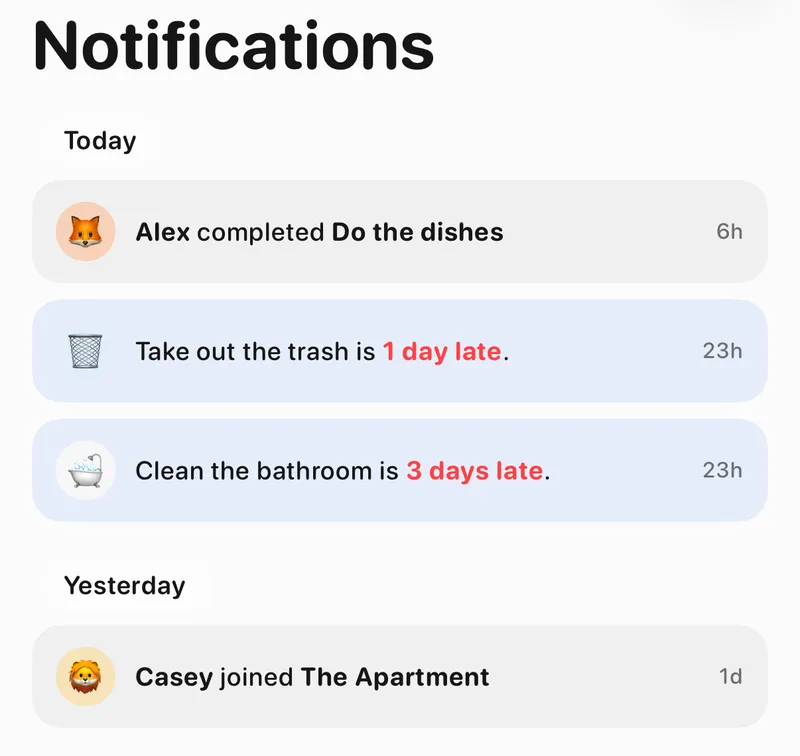
Overdue chores also appear in everyone's in-app inbox, next to who completed what. Roommates who have joined get a notification when a chore rotates to them, when someone assigns them one, and when someone completes a chore.
A few honest details:
- Tidy Up doesn't send a "you're late" alert to the person whose turn it is. Late chores show in the list and the inbox for everyone, which keeps it a fact about the chore. Tidy Up+ adds a morning digest of what's due today, at a time each person chooses.
- Catching up is one tick. When an overdue repeating chore is finally done, its due date moves forward to the next date that's still ahead, so a weekly chore keeps its day and doesn't come back already late.
- The Ranking tab counts one point per completed chore, by week, month or all time, and you can tap a person to see their history. It's useful for "who has done the bathroom lately". It's less useful as a weapon, so bring it to the check-in, not to a fight.
- To rebalance, edit a chore and change who's on it. There's no skip or away button.
- Free covers unlimited people and chores and rotation on up to 3 chores per household. Tidy Up+ unlocks unlimited rotation.
An app won't make anyone want to clean. What it can do is take the reminding, the record-keeping and the "whose turn is it" off the person who cares most, which is usually where the resentment was coming from.

Tidy Up: chores, schedules and turns
Invite your household with one code, set chores to repeat on a schedule, let them rotate so everyone takes turns, and see who did what in the weekly ranking. Free to start, no ads.

Common questions
How do I tell my roommate to clean up without starting a fight?
Do it in person at a calm moment, and talk about one specific thing: say what you noticed, how it affects you, and what you'd like instead, then ask what they think. "Dishes are staying in the sink for days, could we agree on end of the night?" lands much better than "you never clean".
Is it okay to just clean up after my roommate myself?
Once in a while, sure. As a habit, it hides the problem from them and builds resentment in you. If you're regularly doing someone else's share, say so early and plainly.
Do passive-aggressive notes work?
Rarely. CU Boulder's roommate advice warns that texts and sticky notes can lead to misunderstandings or make the situation worse. A two-minute conversation is harder to start and much more likely to work.
What if my roommate and I have different standards of clean?
Then nobody is wrong, and you need a middle that's written down. Agree on what done means for the shared spaces only, and let each person keep their own room how they like.
Can I ask my landlord to make my roommate clean?
Usually not for everyday mess. A landlord may care when it becomes a property issue such as pests or damage, and your lease will say what applies. In university housing, your RA can mediate after you've tried talking first.
When should I give up and move out?
When you've agreed a clear standard, followed up, tried a different split, and it still isn't changing. At that point it's about compatibility. Check your lease dates and plan the move around them.